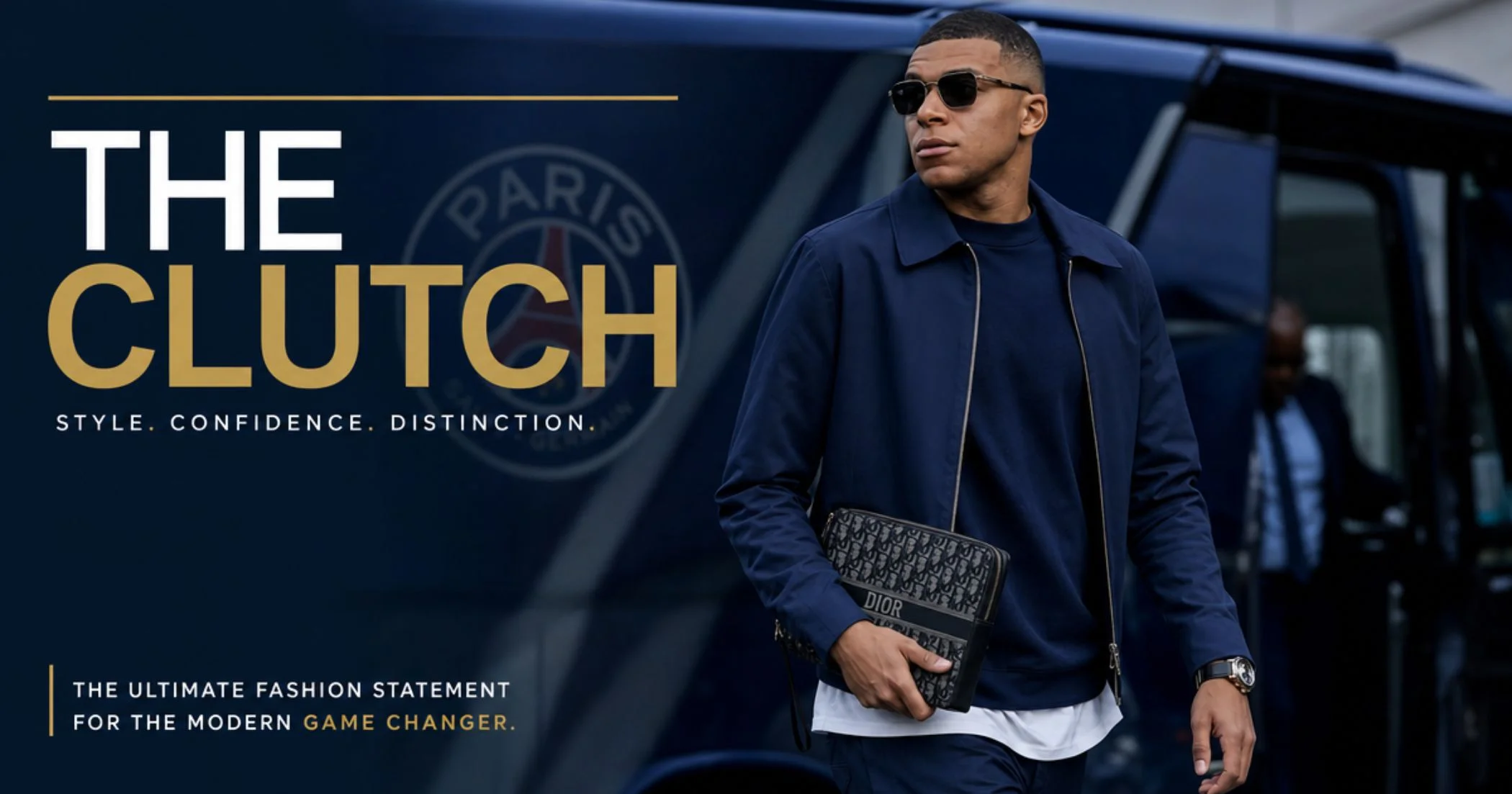
Small clutch bags carried by men have become increasingly visible over the past several months, moving from red-carpet appearances into mainstream menswear. Harry Styles and Bad Bunny helped popularise the look in recent years, while footballers such as Kylian Mbappé and Erling Haaland brought it further into the spotlight by carrying designer clutches and bags around the 2026 FIFA World Cup in the United States, Mexico and Canada. Luxury houses including Dior, Ralph Lauren and Dolce & Gabbana have since incorporated men’s clutches into recent runway collections.
Celebrity Influence
Men carrying small clutches at public appearances is not a new phenomenon. Harry Styles, Bad Bunny, Jacob Elordi and Patrick Schwarzenegger have carried clutches and compact bags at red-carpet events and in paparazzi photographs for several years, according to Yahoo Lifestyle. These bags typically hold only essentials such as a phone, keys and sunglasses.
Other menswear figures have also helped popularise designer bags, including Jacob Elordi, who regularly carries Bottega Veneta pieces, and Timothée Chalamet, who has worn smaller Hermès and Chanel styles, according to CNN Style. While these celebrities did not originate the concept of men carrying bags, historically documented since the 17th century according to Coveteur, their visibility has contributed significantly to its recent resurgence.
Footballers And Luxury Bags
The fashion trend gained further momentum during the 2026 World Cup, as several high-profile footballers carried luxury bags and clutches. Norway striker Erling Haaland frequently carried Hermès bags, including the Birkin, while France forward Kylian Mbappé favoured Dior, reflecting his role as a brand ambassador, according to Marie Claire. Lionel Messi has also built a bag collection spanning Dior, Hermès and Louis Vuitton.
The trend gained a stronger connection to the clutch format during the 2026 World Cup. In May, Mbappé arrived at the French national team’s training base carrying Dior’s A5 Triangle clutch, which cost approximately €1,300 (around 4,700 shekels), according to Ynetnews. During the World Cup, his France teammate Manu Koné carried a yellow Goyard clutch priced at $5,900 (approximately 17,000 shekels).
Key Highlights
Detail
Information
Trend
Men’s clutch bags replacing larger luxury bags
Started By
Celebrities like Harry Styles, Bad Bunny, Jacob Elordi
Boosted By
Footballers like Kylian Mbappé, Manu Koné, Lionel Messi
Example Price
Dior A5 Triangle clutch — about 1,300 euros
Another Example
Goyard clutch worn by Manu Koné — $5,900
Brands Involved
Dior, Hermès, Louis Vuitton, Goyard, Dolce & Gabbana, Ralph Lauren
Key Theme
Clutches functioning as style and status accessories over daily utility
Runway And Brand Adoption
Luxury houses have responded to the visibility of this trend with recent runway presentations. Dolce & Gabbana paired suits and resort wear with clutches, including styles decorated with jeweled charms and others in crocodile-effect leather. Ralph Lauren presented tailored suits alongside leather clutches in a range of sizes, using the accessory to introduce a more relaxed element into formal looks.
Reporting also notes a related trend of men repurposing toiletry bags as day bags, with the distinction between the two categories increasingly blurred in practice.
Why This Matters for Fashion D2C
This shift indicates that established assumptions about “practical” or category-appropriate menswear accessories are loosening. Crossbody bags and belt bags have traditionally been positioned as the safer entry point for men’s bag categories; clutches are now competing for that space. Brands developing men’s accessory lines may want to track this shift in consumer acceptance.
There is also a pricing pattern worth noting. Within luxury houses, clutches typically sit at a lower price point than larger handbags from the same brand, offering a comparatively accessible entry into a “luxury” positioning. D2C accessory brands could apply a similar structure — smaller, design-forward items priced to make a brand’s aesthetic accessible without requiring a flagship-price purchase.
Style Over Functionality
Clutches present clear functional limitations compared to crossbody or belt bags. They occupy one hand, requiring users to set the bag down for tasks such as using a phone, and do not distribute weight the way structured bags do.
This trade-off appears to be part of the accessory’s current appeal rather than an obstacle to it. Reporting on the trend frames clutches, whether from established luxury houses or resale/counterfeit markets, as functioning primarily as status and style signifiers rather than practical daily-carry items. The format’s growing adoption suggests that, within this segment of menswear, visual and brand signalling is currently being prioritised over functional convenience.
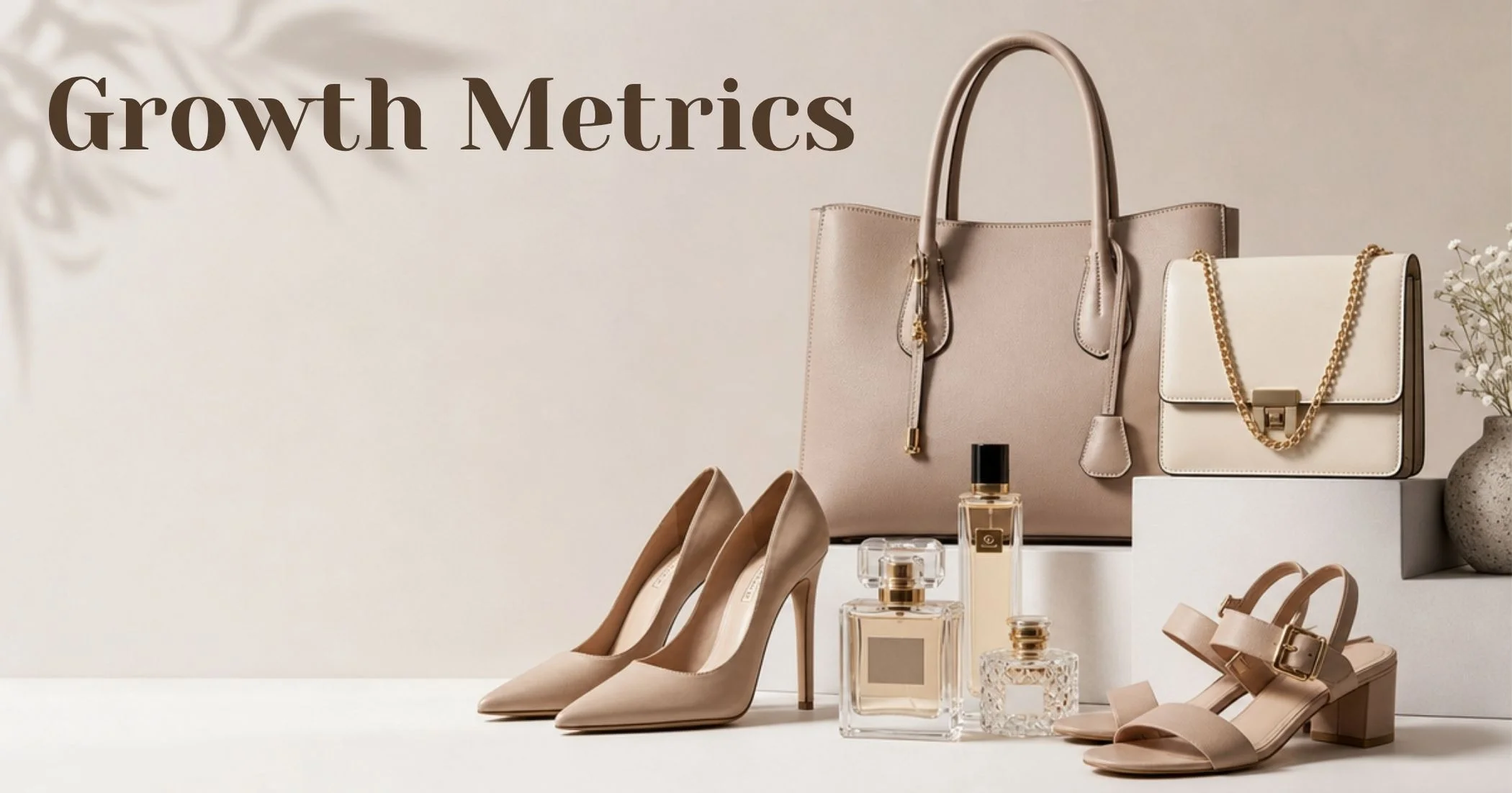
Theater, a D2C fashion and accessories brand, has raised Rs 75 crore in a Series A funding round led by Niveshaay. Physis Capital joined as a new investor, while Prath Ventures, an existing investor, also participated. The round values Theater at approximately Rs 410 crore on a post-money basis.
Theater’s Funding Round
Theater makes footwear, stockings, bags, and perfumes. Four people started the brand in 2021. Their names are Sarthak Aggarwal, Vikram Jain, Karan Jain, and Shruti Aggarwal. The brand calls itself “design-led” and “mass-premium.” That means it sits between cheap mass-market goods and pricey imported luxury brands.
The company plans to use the funds to expand its offline retail footprint and invest in brand-building initiatives, including marketing campaigns and celebrity partnerships. Theater currently operates primarily through digital channels, but intends to grow its physical retail presence significantly.
Sarthak Aggarwal, co-founder and CEO, explained the reasoning behind the brand’s founding. He said the team struggled to find well-made accessories in India that weren’t either imported luxury items or lower-quality alternatives, prompting them to build a brand manufactured in India and priced for consumers who value design without paying luxury prices.
Co-founder Vikram Jain addressed a common assumption in the Indian retail market. He noted that Indian consumers are frequently characterised as prioritising discounts over design. However, he said Theater’s growth suggests otherwise, indicating that consumers are willing to pay for products with a distinct design perspective.
Theatre Brand Raised Funding
Arvind Kothari, Founder of Niveshaay, explained the rationale behind the investment. He said Niveshaay backs category-creating brands that address clear market gaps, noting that footwear, stockings, and bags remain largely unorganised categories in India with limited design-led options. Kothari added that Theater built strong consumer pull organically in these categories.
The company’s financial performance supports this positioning. Theater recorded operating revenue of Rs 33.35 crore in the financial year ending March 2025, representing a 2.37x year-on-year increase. The brand’s previous funding round was a $1.5 million pre-Series A round led by Prath Ventures in September 2024.
Key Highlights
Detail
Information
Brand
Theater
Round
Series A
Amount Raised
Rs 75 crore
Led By
Niveshaay
Other Investors
Physis Capital (new), Prath Ventures (existing)
Valuation
About Rs 410 crore (post-money)
Founded
2021, by Sarthak Aggarwal, Vikram Jain, Karan Jain, Shruti Aggarwal
Products
Footwear, stockings, bags, perfumes
FY25 Revenue
Rs 33.35 crore, up 2.37x from FY24
Past Round
$1.5 million pre-Series A, led by Prath Ventures, September 2024
Why This Matters for Fashion D2C
Theater’s growth suggests increasing consumer willingness to pay for design-led products at accessible price points, rather than defaulting to discount-driven purchasing.
The funding also highlights growing opportunities in underpenetrated fashion-accessory categories. Footwear, stockings, and bags have historically lacked strong design-focused, organised players in India, and Theater’s traction indicates demand exists in these overlooked segments.
This may prompt other D2C brands to consider less saturated categories rather than competing directly in crowded segments such as apparel, where differentiation is harder to achieve.
About Theater
Theater was founded in 2021 by Sarthak Aggarwal, Vikram Jain, Karan Jain, and Shruti Aggarwal. The brand manufactures footwear, stockings, bags, and perfumes, and positions itself as a design-led, mass-premium label priced above mass-market offerings but below imported luxury brands.
What Happens Next?
Theater plans to use the new capital to expand its offline retail presence and increase investment in marketing and celebrity partnerships, while continuing to grow its digital-first business.
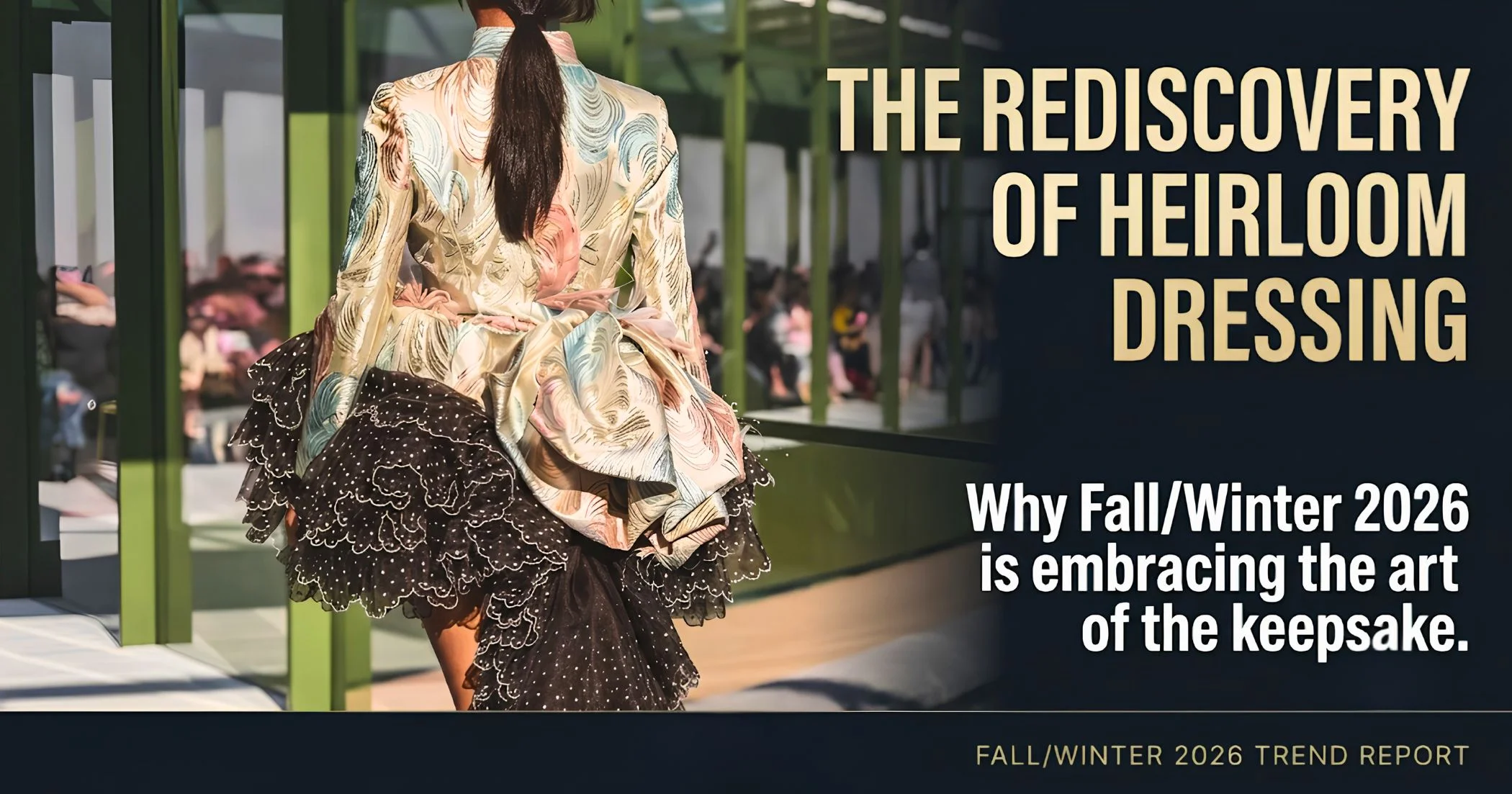
Brocade, jacquard, velvet — fabrics that used to sit in the “special occasion only” pile are back on the fall/winter 2026 runways, and not as a one-off nostalgia trip. Dior, The Row, Reem Acra, Krikor Jabotian, Gemy Maalouf — all of them leaned into heavier, old-world textiles this season instead of chasing whatever’s next. Something in fashion right now is asking a different question than usual: not what’s new, but what’s actually worth keeping.
Heritage Fabrics Return to the Runway
Dior’s metallic jacquards had that antique-tapestry look — richly embroidered jackets that wouldn’t feel out of place on a Medici portrait. The Row went a stranger route with velvet: narrow strips worked into a fluid skirt, a coat that borrowed from Tudor court dressing but didn’t try to look like a costume. Reem Acra pushed brocade into full sweeping gowns, floral patterns dense enough that they read more like textile art than something you’d wear to dinner.
Acra puts it down to fatigue — years of minimalism and casual dressing have left people wanting clothes that feel like they mean something. She says velvet, jacquard, and brocade create a richness that plainer fabrics cannot match because their luxury comes from the weave itself, not from anything added on top. While heavier heritage textiles are making a comeback, cotton and linen continue to offer a lighter alternative for everyday dressing, showing how different fabrics can serve very different style needs.
Brocade gets its raised pattern from extra threads worked into the weave itself; jacquard’s motifs come straight off the loom, built into the structure of the cloth rather than stitched on after.
Krikor Jabotian, who’s built a name blending old-world grandeur with modern tailoring, is blunter about it: these fabrics can’t be rushed, full stop. They need a skilled hand and they take time — no shortcuts. “Today, true luxury is defined by patience, narrative and time,” he says. Gemy Maalouf, working out of Beirut, echoes something similar. Her latest collection combines devoré and appliqué to make velvet gowns feel lighter, less stiff — and she thinks that’s part of why these fabrics keep pulling women back in. Wearing something that feels special, she says, still carries weight.
Key Highlights
Detail
Information
Trend
Return of heritage fabrics — brocade, jacquard, velvet
Season
Fall/Winter 2026 collections
Key Designers
Dior, The Row, Reem Acra, Krikor Jabotian, Gemy Maalouf
Core Shift
Trend-driven dressing giving way to craft-led, lasting pieces
Craftsmanship and permanence winning out over novelty
Working with Difficult, Historic Materials
None of this is easy to pull off. These fabrics are heavy, stiff in places, hard to cut and drape — and because they carry so much historical baggage, it’s easy for a garment to tip from couture into costume without much warning. That line is the real challenge of the season.
Acra’s answer was to keep things bold but controlled: skirt sets in metallic copper-and-turquoise brocade, 1980s-leaning off-the-shoulder gowns in heavy floral jacquard. Her approach — cleaner lines, lighter construction underneath, modern colour choices, sometimes pairing the stiff fabric with something fluid just to loosen it up. Nothing too literal, nothing too “period drama.”
Why This Matters for Fashion D2C
There’s a practical takeaway here for smaller labels. Heavy, richly woven fabric doesn’t have to mean heavy, old-fashioned shapes — pair it with a clean, contemporary cut and it reads modern instead of costume-y. That’s a formula D2C occasionwear brands can borrow without needing a couture atelier behind them.
It also says something about where spending is heading. People aren’t necessarily chasing the newest drop right now — they want something that feels considered, made to last. Brands built around craft or regional textile work have an opening here to lead with that story instead of competing purely on turnaround speed or price.
About the Designers
Reem Acra is a Lebanese-American designer based in New York, best known for eveningwear and bridal collections built around opulence. Krikor Jabotian, Armenian-Lebanese, has made his name with dramatic silhouettes rooted in traditional craft. Gemy Maalouf works out of Beirut and is known for pairing classic techniques like devoré and appliqué with contemporary shapes.
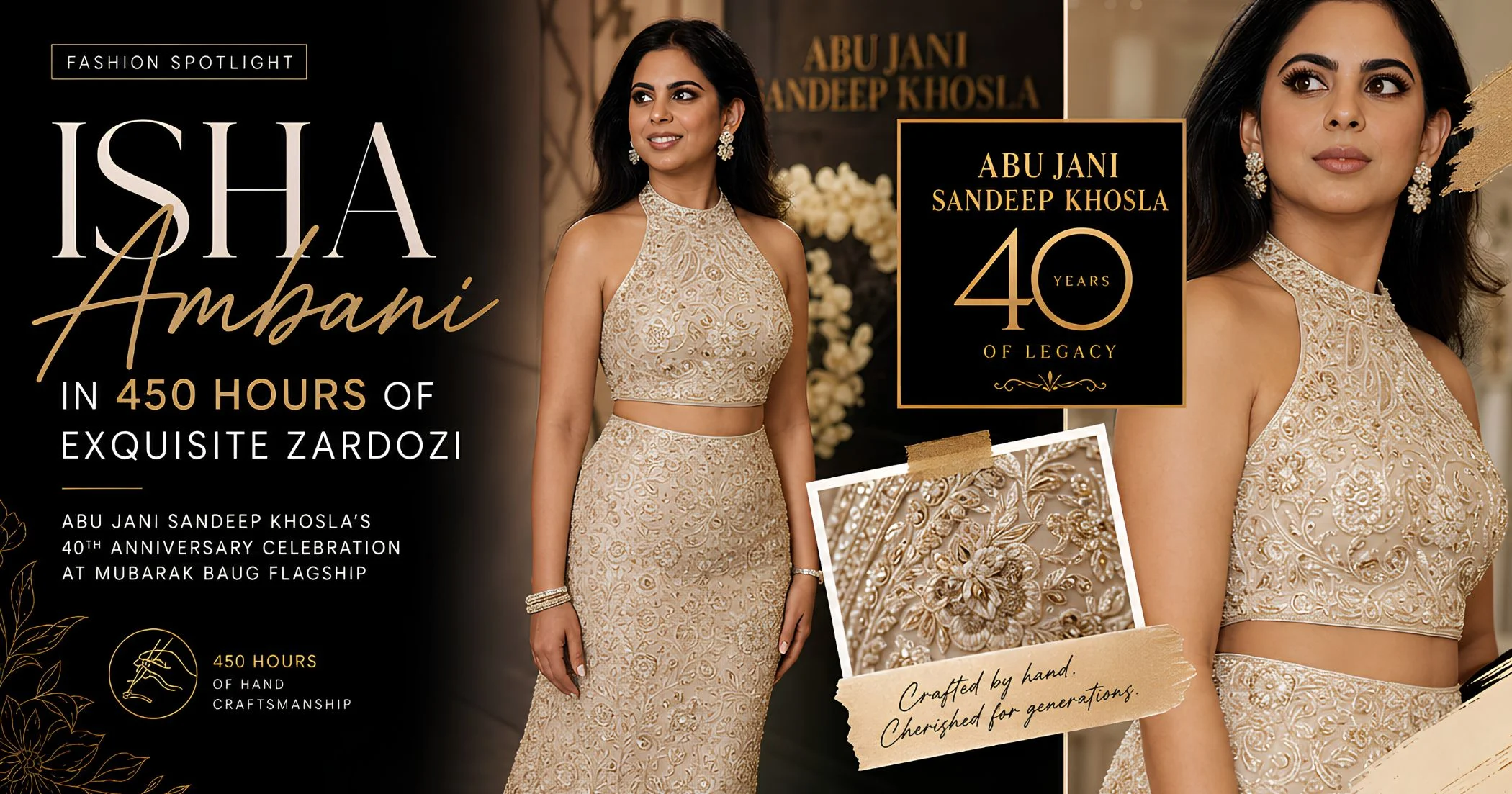
Abu Jani and Sandeep Khosla marked 40 years of fashion with a grand celebration in Mumbai. The event brought together stars, models, and long-time friends of the designers. Isha Ambani attended the celebration in a custom zardozi skirt set that took nearly 450 hours to make by hand. The look mixed old Indian craft with a modern shape and was part of the celebrations around the designers’ new flagship, Mubarak Baug.
Abu Jani Sandeep Khosla’s 40th Anniversary Celebration
Abu Jani and Sandeep Khosla’s 40th anniversary celebration brought their four-decade fashion journey into one big event. The celebration took place at Mubarak Baug, their new flagship in South Mumbai, inside the historic Framjee Cawasjee Institute.
The space was made to show the world of the designers. It brings together couture, craft, art, jewellery, and pieces from their past. The new flagship covers about 20,000 square feet and was designed as an immersive space rather than a simple fashion store.
The event had many well-known names from Indian fashion and film. Nita Ambani, Isha Ambani, Shloka Ambani, and Radhika Ambani attended the celebration in looks by the designers. Models who had worked with the duo in the past returned for the show, adding a special link to the brand’s history.
Key Highlights
Detail
Information
Event
Abu Jani Sandeep Khosla’s 40th anniversary celebration
Venue
Mubarak Baug, Mumbai
Designers
Abu Jani and Sandeep Khosla
Isha Ambani’s Look
Custom zardozi-embroidered skirt set
Craft Time
Nearly 450 hours
Main Craft
Aari and zardozi embroidery
Design Detail
Mughal-inspired jaali motif
Stylist
Andrew Mukamal
Jewellery
From Nita Ambani’s personal collection
Isha Ambani’s 450-Hour Zardozi Skirt Set
Isha Ambani wore a custom skirt set made by Abu Jani Sandeep Khosla for the celebration. The outfit had a fitted halterneck blouse and a long skirt with rich embroidery.
The piece was made new for the event. It was not an old look from the designers’ archive. The handwork took close to 450 hours, with the outfit made over about six weeks.
The set used a Mughal-inspired jaali design. Artisans covered the fabric with aari and zardozi work. Swarovski crystals, pearls, and bugle beads added more shine to the look.
The halterneck gave the outfit a fresh feel. Its clean shape brought a light, modern touch to the heavy handwork. The result was closer to elegant eveningwear than a traditional lehenga.
The Craftsmanship Behind Isha Ambani’s Look
The main beauty of the outfit comes from its handwork. Artisans used aari and zardozi to create the detailed patterns across the skirt and blouse.
The jaali motif has a strong Mughal influence. It looks like a fine, open pattern and gives the outfit a rich texture.
The motif also has a history with the fashion house. A similar jaali design appeared in the brand’s 2009 Abaan collection. The new look takes ideas from the designers’ Raj collection too, giving an older craft a newer feel.
How Isha Ambani Styled the Look
Stylist Andrew Mukamal styled Isha’s look. He kept the accessories polished so they did not take attention away from the detailed embroidery.
Isha wore a diamond and pearl choker, statement diamond earrings, and a diamond-encrusted ring. The jewellery came from Nita Ambani’s personal collection.
She finished the look with crystal-covered heels from Italian brand René Caovilla and a metallic chainmail top-handle bag.
Why This Matters for Fashion D2C
Isha Ambani’s look shows how Indian craft can work with a modern fashion shape. The outfit keeps traditional zardozi and aari work at the centre, but the clean halterneck and long skirt give it a fresh evening look.
This is useful for fashion D2C brands, especially those making wedding and occasion wear. Customers are looking for special pieces that feel rich but do not always look like a classic lehenga. A simple shape with detailed handwork gives brands another way to create statement occasionwear.
The event itself gives another lesson. Mubarak Baug is more than a store. It brings fashion, craft, art, jewellery, and the brand’s archive into one space. That kind of experience can help a fashion label tell a stronger story around its products and its craft.
About Abu Jani Sandeep Khosla
Abu Jani and Sandeep Khosla began their design partnership in 1986. For four decades, they have built their name around rich Indian craft and couture. Their work is known for techniques such as zardozi, chikankari, mirror work, and detailed embroidery. Their 40th anniversary celebrates both their long journey and the craft behind the house.
Standing in front of a rack, staring at a price tag that’s easily double what you’d normally pay for jeans, wondering if selvedge denim actually earns that jump? A lot of people land on this exact question before buying their first pair.
This guide walks through the real trade-offs, cost, comfort, durability, different denim fits, and fade quality, so you can decide for yourself rather than just trusting whatever the marketing copy tells you.
TL;DR: Is Selvedge Denim Worth Buying?
Selvedge denim is worth buying if you care about how fabric ages over time, don’t mind a stiffer break-in period, and plan to wear one pair regularly instead of rotating through several. It’s probably not worth it if you want comfortable jeans right out of the bag, since well-made premium denim without selvedge edging delivers similar durability for less money and no waiting period.
What Makes Selvedge Denim Different From Regular Denim?
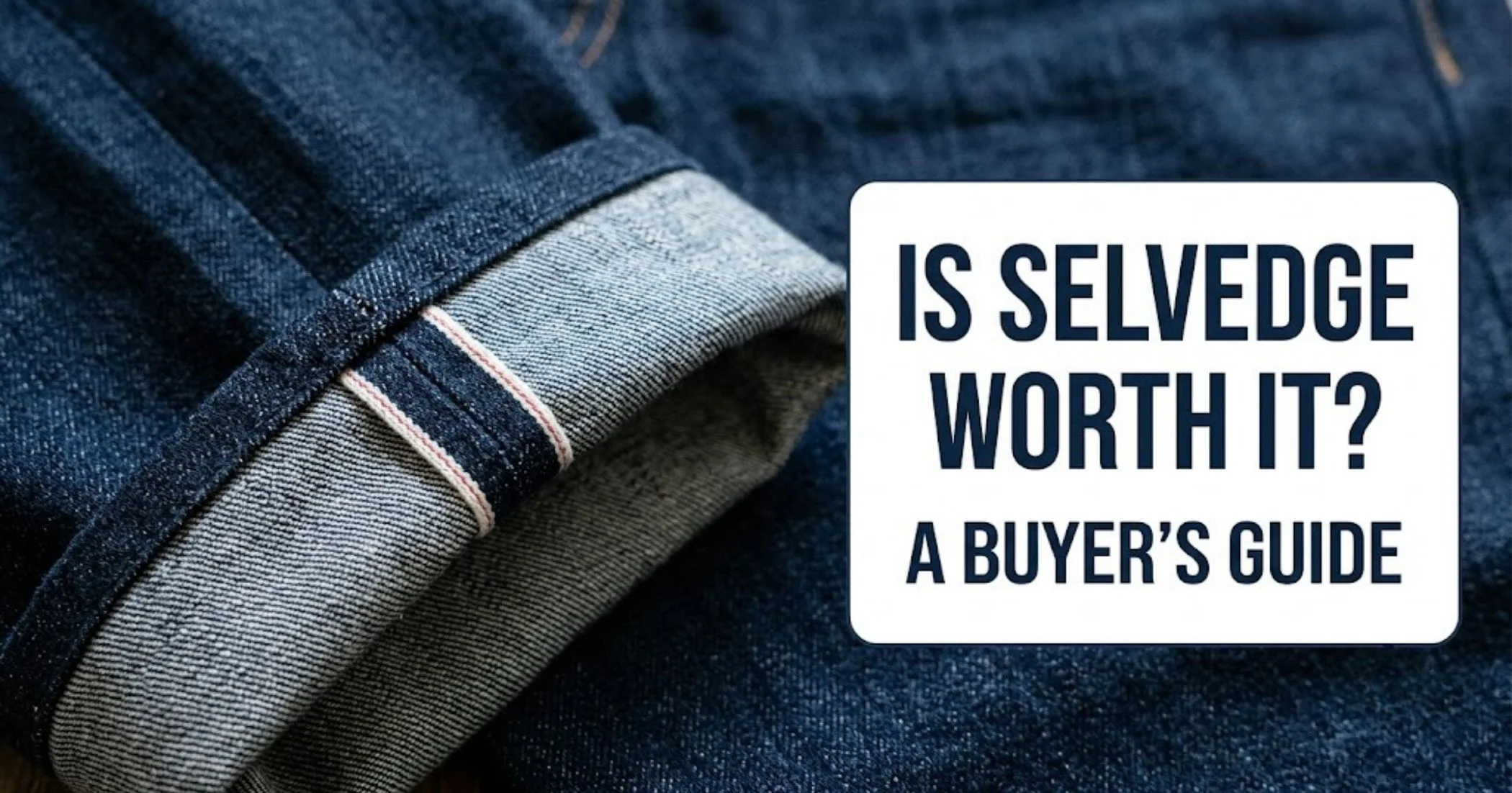
The difference comes down to how the fabric gets woven, not the wash, the brand, or anything you’d notice at a glance. Selvedge denim is produced on older shuttle looms that finish each edge with a tight, self-sealed border, so the fabric never frays without extra stitching.
Standard denim comes from faster, modern looms that leave a raw edge needing separate binding. That single manufacturing difference explains most of what separates selvedge jeans from everything else on the shelf.
How a Shuttle Loom Produces Selvedge Denim
A shuttle loom weaves fabric using one continuous thread that shuttles back and forth across the width of the cloth. That back-and-forth motion naturally seals the edge, since the thread never actually breaks at the border the way it does on a modern projectile loom.
What the Selvedge Edge Tells You About the Fabric
That thin colored line running along the inside seam isn’t decoration. It marks which mill or batch produced the jean selvedge fabric, and some denim collectors track specific colors the way sneaker collectors chase certain releases. Beyond that, the edge itself signals the fabric came off a shuttle loom rather than a faster modern machine.
What Are You Paying More for With Selvedge Denim?
Cost is usually the first question people have, so it deserves a direct answer. Selvedge denim jeans typically run two to five times the price of standard denim, and that gap comes from a handful of specific factors rather than pure brand markup.
Shuttle looms run far slower than modern equipment, which drives up labor time per yard of fabric produced. The resulting fabric also comes out narrower, meaning more material gets used per pair, adding cost before a single seam gets sewn.
How Fabric Quality and Construction Affect the Price
Beyond the loom itself, a lot of selvedge jeans get produced in smaller batches instead of mass quantities. Limited runs cost more per unit to manufacture, and that expense passes straight through to the price tag you see in-store or online.
Why a Higher Price Does Not Always Mean Better Jeans
A high price doesn’t automatically guarantee superior construction. Stitching quality, fabric weight, and overall fit matter just as much as the loom type used. Plenty of well-made premium denim without any selvedge edging outperforms a poorly constructed selvedge pair on nearly every practical measure.
Is Selvedge Denim More Durable Than Regular Denim?
Honestly, durability comes down to fabric weight and how well the jeans are put together, not just whether the edge is selvedge or not. You could buy a heavy, solidly made pair of raw denim with no selvedge at all, and it’ll outlast a thin, lightweight selvedge pair without breaking a sweat.
How Denim Weight Affects Strength and Comfort:
Denim weight is measured in ounces per square yard, and honestly, this number tells you more about durability than the selvedge label ever will. Go lighter, say 10 to 12 ounces, and you get jeans that feel soft and easy right away, but they won’t hold up as long. Heavier cotton fabric, 14 ounces or more, feels stiff at first. Stick with it though, and it keeps its shape and lasts a lot longer.
Why Fit and Construction Matter for Long-Term Wear:
Stitching matters too, especially at the spots that take the most stress, like the inseam and pocket corners. It’s honestly just as important as the fabric quality itself. You can have great denim, but if the construction is weak everywhere else, the jeans will still wear out fast, no matter how nicely the edges were woven.
Are Selvedge Jeans Comfortable Enough for Everyday Wear?
Comfort is where a lot of first-time buyers get caught off guard. Most raw selvedge denim contains zero stretch, built entirely from rigid cotton with no give at all when you first pull it on.
Stretch denim, by comparison, moves with your body from the very first wear thanks to a small percentage of elastane blended into the fabric. If daily comfort ranks above fabric history on your priority list, this difference alone might answer the “worth it” question before price even enters the conversation.
Why Raw Denim Can Feel Stiff When New
That initial stiffness isn’t a flaw. It’s simply how untreated, rigid cotton behaves before it’s been worn or washed even once. Give it a few weeks of regular wear, and the fabric softens noticeably as it molds to your body, though that adjustment period is real and worth planning around.
When Stretch Denim May Be a Better Choice
If your daily routine involves a lot of movement, physical work, long commutes standing or sitting, stretch denim usually serves you better than rigid selvedge. Comfort compounds daily, while fade character only pays off after months of patient wear.
Should You Buy Raw Denim Jeans or Washed Selvedge Denim?
Not every selvedge pair arrives untreated. Plenty of brands take selvedge fabric and put it through washing and softening before it ever reaches a shelf, which changes the experience significantly compared to buying raw.
What to Expect From Raw Denim
Raw denim stays stiff, deep in color, and completely unwashed until you decide otherwise. Many enthusiasts wait months before that first wash specifically to let fade patterns develop naturally based on their own movement and habits.
Why Washed Selvedge Denim Can Be Easier to Wear
Washed selvedge still carries that signature edge detail, just without the stiff, unbroken-in feel raw denim brings. If you’re comparing different denim washes, the finish can also change how the final pair looks and feels.
Is Japanese Denim Worth Paying More For?
Not all selvedge denim jeans sit at the same price point, and that range matters when deciding what fits your budget. Japanese denim mills often produce small-batch fabric using traditional indigo dyeing techniques, and that limited production tends to push prices toward the top of the category.
What Makes Japanese Selvedge Denim Popular
Japanese selvedge denim built its reputation partly because Japan kept vintage American shuttle looms running long after most Western mills switched to faster modern equipment. That preservation shaped a whole production culture around smaller runs and specialized dye methods, though quality selvedge does come from other countries too.
How Levi’s Selvedge Compares for First-Time Buyers
Levi’s selvedge is probably the easiest entry point into this category. They run their own shuttle-loom production, but without the premium markup boutique Japanese mills tend to charge. If you’re not sure selvedge fits your lifestyle yet, starting here makes more financial sense than jumping straight to a high-end Japanese pair.
Do Selvedge Jeans Actually Develop Better Denim Fades?
Honestly, this is the strongest argument selvedge has going for it, and it holds up. Dense, tightly woven fabric takes indigo dye differently than a looser weave, creating sharper contrast between the dyed surface and the white core underneath as denim fades develop.
Those fades track your actual movement. Creases behind the knees, lightening at the pockets where your hands rest constantly, wear patterns unique to how you sit and walk each day. No two pairs age the same way, which is really the whole draw for people who deliberately avoid washing for months.
Fade quality depends heavily on fabric weight, dye method, and how consistently you wear the jeans, not just whether the edge happens to be selvedge. A lighter, poorly dyed selvedge pair can fade less dramatically than a heavier standard pair with a rich indigo base.
How Much Should You Spend on Selvedge Jeans?
Budget matters more here than most buying guides admit. Spending more doesn’t automatically buy you a better experience if comfort or low maintenance matter more to you than craftsmanship and patience.
Entry-level selvedge, brands like Levi’s, runs a bit above standard premium denim while still delivering real shuttle-loom construction. Higher-end options, especially from boutique Japanese mills, climb a lot more, mostly because of limited runs and heavier fabric weights.
Deciding between mid-range selvedge and quality premium denim without the selvedge edge? It comes down to how much you personally value that edge detail and the fade character specifically. Both deliver solid durability, so the extra cost for selvedge is really buying you those two things, not overall better quality.
How to Choose Selvedge Jeans That Suit You
Once selvedge feels like the right call for your priorities, a few practical checks make the purchase easier and cut down on buyer’s remorse.
Choose the Right Fit and Measurements
A lot of raw selvedge pairs come unsanforized, meaning they were never pre-shrunk at the mill. These can shrink up to ten percent on that first wash, so sizing up slightly and letting the fabric shrink through wear usually works better than buying something that fits perfectly off the shelf.
Consider Fabric Weight and Your Climate
Lighter weights suit warmer climates and everyday comfort. Heavier weights hold up better in cooler weather and tend to develop more pronounced fades. Match the weight to how and where you’ll actually wear the jeans, not whatever sounds most impressive on a product page.
Think About How Often You Will Wear Them
Fade development really depends on consistent wear. If a pair mostly sits in your closet, the fading slows down, and a good chunk of the whole selvedge appeal disappears with it.
Who Should Buy Mens Selvedge Jeans?
Mens selvedge jeans tend to attract a specific kind of buyer, someone who genuinely enjoys breaking in a stiff pair and watching it change over time. If that sounds like you, the investment usually pays off, both in satisfaction and in how long the jeans last.
If you wear the same pair several times a week, you’ll get the most out of selvedge construction, since frequent wear is exactly what produces those fade patterns everyone talks about.
Regular or Stretch Denim May Suit Comfort-First Buyers
If you wash your jeans often, need comfort right away for an active routine, or just want reliable basics without extra ritual, standard or stretch denim will probably serve you better. No shame in admitting selvedge just isn’t for everyone.
If you’re building a versatile everyday closet, streetwear wardrobe essentials can help you focus on practical pieces that work across different outfits.
What to Check Before Buying Selvedge Denim
Check the Denim Fabric and Construction
Don’t lean on the selvedge label alone to signal good construction. Look at fabric weight, check stitching at stress points, and get a real feel for the overall build.
Compare the Price With What You Are Actually Getting
Weigh the price against fabric weight, brand reputation, and country of production, rather than assuming a higher price automatically means better jeans.
Consider Care, Washing, and Break-In Requirements
Raw selvedge wants cold water, gentle care and washing, and air drying to protect the fade pattern. Washed versions need a lot less special care. Worth factoring that maintenance commitment in before you buy.
Conclusion
Weighing everything together, selvedge denim earns its price tag for a specific kind of buyer, not everyone shopping for jeans. If you value craftsmanship, enjoy tracking how fabric ages, and don’t mind trading immediate comfort for a longer payoff, the investment holds up well.
For anyone prioritizing comfort, low maintenance, or simply wanting solid jeans without extra thought, quality premium denim without selvedge construction delivers similar durability and looks at a friendlier price, without asking you to wait months for the fabric to feel right.
FAQs
Is selvedge denim really better quality than regular denim?
Not automatically, no. It’s woven differently, tighter weave, self-finished edge, but overall quality still comes down to fabric weight and construction, not the selvedge label alone.
How much more expensive is selvedge denim compared to regular jeans?
Typically two to five times the price of standard denim, driven by slower production, narrower fabric width, and smaller batch manufacturing runs.
Does selvedge denim come with any stretch?
Rarely. Most selvedge fabric stays rigid cotton without stretch, though a small number of brands have started blending in minimal elastane for added comfort.
Is Japanese selvedge denim always the best option?
Not necessarily the best, just often pricier because of small-batch production. Levi’s selvedge and other brands offer solid quality at more accessible price points.
How long should I wear selvedge jeans before washing them?
Many enthusiasts wait three to six months to let fade patterns develop naturally, though honestly this comes down to your own comfort with visible wear, and the smell, before that first wash.
Pull up nearly any pair of jeans right now and check the fit name on the tag. Slim. Straight. Tapered. Odds are good that fit traces its roots directly back to Levi’s, a brand that didn’t just make jeans, it basically invented the language everyone in denim still uses to describe them.
This piece walks through how one company’s numbered lots turned into the blueprint the entire industry still builds on, from the original 501 through modern releases like the Ribcage Straight. Along the way, you’ll see how a single practical fix for gold rush miners eventually shaped the denim jacket in your closet and probably a pair of jeans you’re wearing right now.
TL;DR – What Made Levi’s the Blueprint for Denim
Levi’s started as workwear built for gold rush miners who needed pockets that wouldn’t tear apart under strain. That single practical fix, a copper rivet, turned into a patent, then an industry. Decades later, the numbered lots Levi’s assigned to different cuts, 501, 505, 511, 512, became the reference point every other denim brand measures their own fits against, even today.
Where It All Started – Levi Strauss and the Gold Rush Roots of Denim
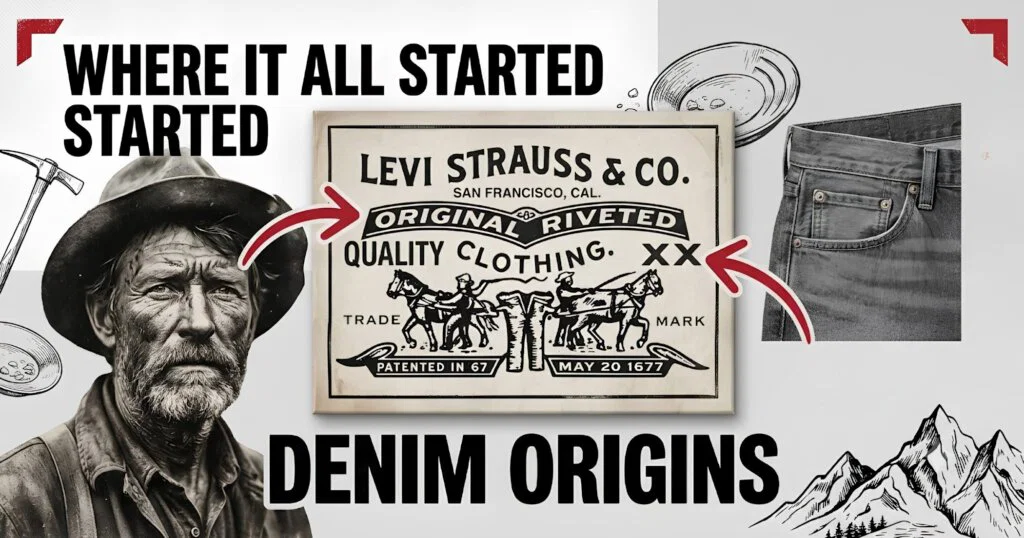
Levi Strauss arrived in San Francisco in the 1850s selling dry goods to miners flooding into California during the California gold rush. He wasn’t making jeans at first. He was selling fabric and supplies to people digging for gold in brutal, physically demanding conditions, the kind of work that chewed through ordinary clothing fast.
That environment created a real problem. Miners needed pants tough enough to survive constant crouching, digging, and rock scraping, and standard trousers at the time simply couldn’t hold up. Fabric tore, seams gave out, and pockets ripped apart under the weight of tools and ore samples. It wasn’t a fashion problem. It was a durability problem, and durability problems tend to produce practical solutions rather than stylish ones.
This is worth remembering any time Levi’s gets talked about as a fashion brand first. The company’s roots aren’t in runway trends. They’re in a very unglamorous need that had nothing to do with looking good and everything to do with clothing that could survive a workday.
The Rivet That Started Everything
The actual breakthrough didn’t come from Strauss directly. It came from a tailor named Jacob Davis, based in Nevada, who’d been reinforcing pants pockets with copper rivets after a customer asked him to make a tougher work pant for her husband. Davis had the fix. What he didn’t have was the money to file a patent on his own, so he wrote to Strauss, his fabric supplier, and proposed they patent it together.
Why Miners Needed Jeans That Wouldn’t Fall Apart
Pockets kept ripping at the corners under the weight of tools, nails, and mining equipment stuffed inside them. Regular stitching wasn’t built to handle that kind of constant strain, day after day, in rough working conditions. A pocket seam might survive a week of light use, but a miner’s pocket was getting stressed constantly, and thread alone couldn’t hold up.
Davis noticed this firsthand through his own tailoring work, watching customers come back again and again with the same torn pockets. His fix was simple: metal rivets placed directly at the stress points, doing mechanically what stitching alone couldn’t.
How a Small Patent Turned Into an Industry Standard
Davis and Strauss filed their patent on May 20, 1873, for copper rivets placed at pocket corners and points of strain. That patent effectively created the modern blue jean as a product category, not just a Levi’s product specifically, but the whole idea of riveted, durable work pants. Once the patent existed, Levi Strauss & Co. had something no competitor could legally copy, at least for a while, and that gave the company room to build a real identity around durability before anyone else could compete on the same terms.
Levi’s 501 – The Jean That Defined a Category
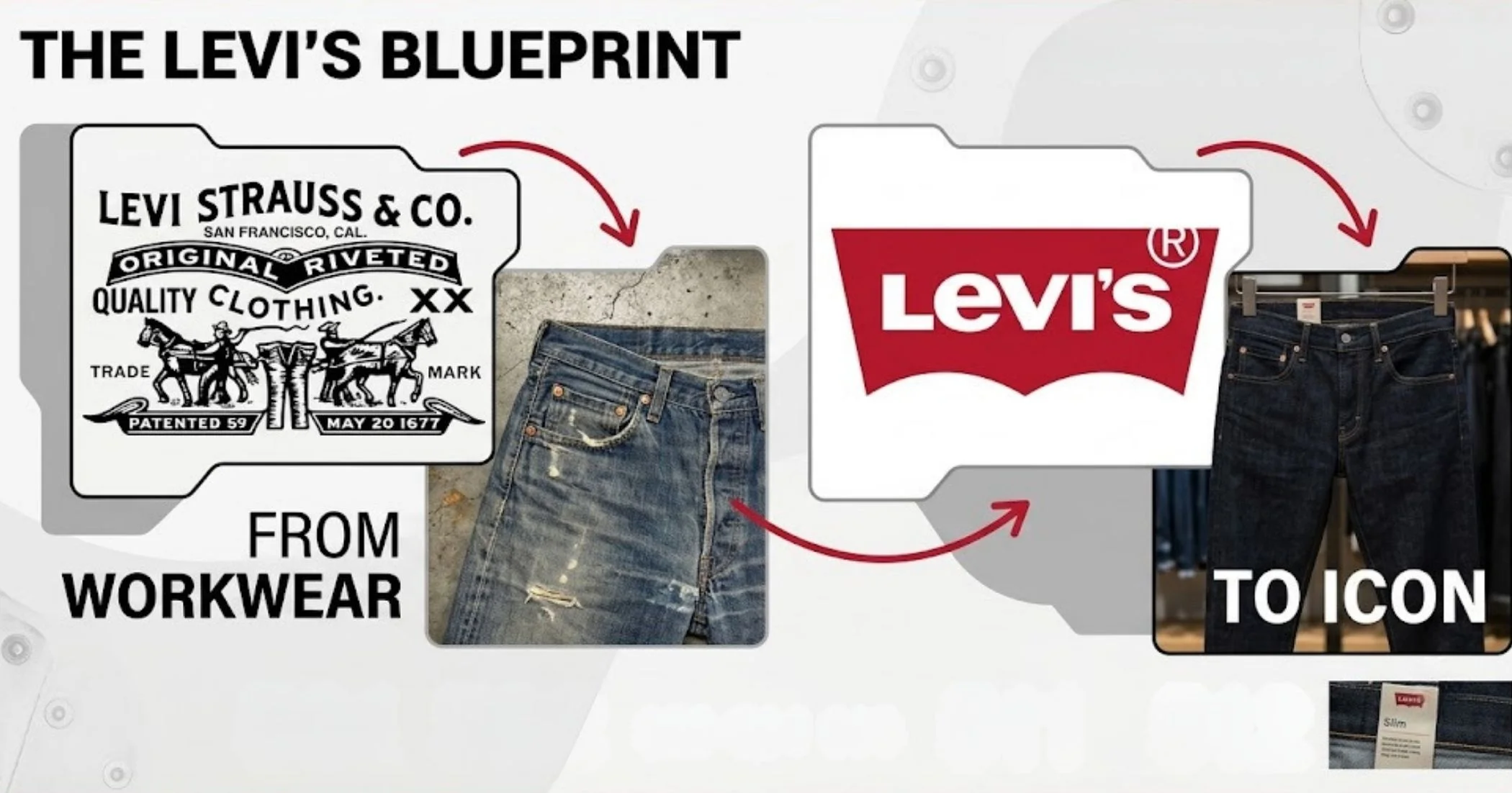
If one single product explains why Levi’s jeans became a household name, it’s the Levi’s 501. This isn’t just another style in the catalog. It’s the original template that nearly every straight-leg jean since has measured itself against, whether the brand making it acknowledges that lineage or not.
1890 and the Birth of Lot Number 501
The number itself comes from a simple internal lot numbering system Levi’s used for tracking different fabric bolts and cuts. Lot 501 happened to be the one that stuck, and it’s remained in continuous production since 1890, making it one of the longest-running clothing products in American history. The timing wasn’t random either. The original 1873 rivet patent expired around 1890, which meant competitors could suddenly legally copy the riveted design. Levi’s response was to lean into lot numbers as a way to distinguish its own product line from the flood of copycats entering the market.
The jean itself kept quietly evolving after that. The rivets on the back pockets, originally exposed on the outside, stayed that way until 1937, when complaints from cowboys about the metal scratching saddles and furniture forced Levi’s to move them inside. A few years later, the rivet at the crotch was removed entirely, reportedly after complaints that it heated up dangerously fast for anyone sitting too close to a campfire. Small, practical fixes like these are part of why the 501 kept working for the people actually wearing it, not just the people designing it.
What Makes the 501 Fit Different From Other Straight Jeans
The Levi’s 501 sits at the natural waist with a straight leg that doesn’t taper or flare dramatically anywhere along its length. That neutral, uncomplicated silhouette is exactly why it became the reference point other brands still describe their own straight-leg cuts against, even decades later. It doesn’t chase a specific era’s idea of what looks good, which is part of why it hasn’t aged out the way more trend-driven fits eventually do.
Why the 501 Still Sells Decades Later
Trends shift constantly in fashion, but the 501 keeps selling because it never tried to chase any of them specifically. It’s a timeless, versatile fit that works across generations, which explains why you’ll spot the same style on teenagers and their grandparents alike.
How Levi’s Shaped the Way We Think About Denim Fit
Once the straight leg was established, Levi’s expanded the lineup with different cuts designed to serve different body types and style preferences, effectively building the vocabulary the entire industry now uses. Instead of describing fits in vague terms, the brand gave shoppers actual numbers to reference, and that habit stuck well beyond Levi’s own product lines.
Levi’s 511 and the Rise of the Slim Fit Era
Levi’s 511 arrived as a response to the slim-fit trend that swept through menswear, offering a leg that sits closer to the body without going full skinny. This fit became hugely popular for Levi jeans for men who wanted something more tailored than the classic straight leg, without going all the way to the tighter cuts other brands were pushing at the same time.
Levi’s 505 and the Straight Leg That Never Left
The Levi’s 505 sits in an odd middle spot, not quite the 501, not quite one of the slimmer cuts either. It’s got a straight leg, sure, but the rise and overall fit feel a touch more modern than the original. Honestly, that’s probably why it’s stuck around this long. It doesn’t fully commit to classic or contemporary, so it works as a safe pick for anyone who’s not sure which fit to grab first.
Levi’s 512 and Where Slim Taper Fits Into the Lineup
The Levi’s 512 does something the 501 and 505 don’t bother with, it tapers. The leg narrows gradually as it moves from the thigh down toward the ankle instead of staying the same width the whole way. Good option if you want a slimmer look near your ankles but still want some breathing room up top.
Levi’s Beyond Jeans – The Trucker Jacket and Everyday Casual Wear
Jeans built the Levi’s name, but the brand didn’t stop there. Casual wear and everyday denim pieces became a big part of the story too. These pieces also helped shape the kind of practical, versatile clothing that later became central to modern streetwear wardrobes.
That same idea behind the 501, durability over flash, carries straight through into everything else they make.
How the Trucker Jacket Became a Wardrobe Staple
The trucker jacket followed roughly the same arc as the 501. Started off as tough workwear, eventually turned into something people just wanted to wear because it looked good. Levi’s was making denim jackets as far back as the 1880s, and collectors today still label them using the same Type I, Type II, Type III system the brand came up with. Type III is basically what everyone calls a trucker jacket now. That kind of versatility is exactly what makes a piece valuable when building a capsule wardrobe. Plenty of women reach for it just as often as men do too.
How Levi’s Shirts Became a Staple of Everyday Casual Wear
Button-down shirts came next, along with other denim pieces built with that same no-nonsense, built-to-last mindset their jeans always had. Together, these pieces rounded out a whole casual wardrobe built around denim as a fabric, not just something you wear on your legs. What started as rugged Western wear for cowboys eventually became something people just liked wearing, because it looked good and lasted.
How Levi’s Keeps Its Denim Relevant in Modern Fashion
Lasting 150-plus years takes more than resting on old reputation. Levi’s kept rolling out fits that respond to whatever’s trending at the moment, while somehow never losing what makes them recognizably Levi’s.
Where Levi’s Ribcage Straight Fits Into the Current Denim Trend
The Ribcage Straight is Levi’s answer to the recent pull toward higher rises and looser, straighter legs, a look that’s basically taken over women’s denim the past few years. It’s the same straight-leg thinking from the 501, just reshaped for a completely different silhouette, without losing the appeal that made the original work in the first place.
Levi’s Cargo Pants and the Brand’s Move Into Streetwear
Cargo pants are the newest move, mixing Levi’s usual fabric know-how with the utility-heavy look streetwear has leaned into hard lately. It’s a real step outside straight and slim jeans, into space that other denim brands have owned for a while now.
Why Levi’s Still Sets the Standard for Denim Style
Brands come and go in denim, that’s nothing new. American Eagle and plenty of others have built whole product lines on fits Levi’s was doing decades before them, whether that’s a straight trouser cut or a slim taper leg. Newer brands can absolutely make solid jeans, sure, but they’re still building inside a framework Levi’s put down generations back.
A lot of that staying power actually traces back to right after World War II, when jeans stopped being purely functional and turned into something closer to a symbol of youth pushing back against convention. Marlon Brando, James Dean, both wore Levi’s on screen through the 1950s, and that image stuck. Denim wasn’t just something you wore because you had to anymore. People started choosing it.
And it’s not just nostalgia keeping Levi’s relevant today either. Their numbering system, 501, 505, 511, 512, turned into shorthand the whole industry picked up, even brands that use totally different naming systems for their own similar fits.
The Bottom Line: Levi’s Didn’t Just Sell Jeans, It Built the Category
From that original rivet patent all the way to newer releases like the Ribcage Straight, Levi’s didn’t just show up and participate in denim as a category. They built the category, more or less from nothing, then kept growing it decade after decade without ever losing the thread back to that very first pair of riveted work pants.
Next time you put on jeans, doesn’t matter if they’re actually Levi’s or some other brand entirely, you’re wearing something shaped by decisions this one company made well over a century ago. Kind of a strange legacy for a brand that started out just trying to stop a miner’s pocket from ripping.
Levi’s helped turn denim from practical workwear into an everyday fashion staple, a shift that continues to shape denim and streetwear fashion today.
FAQs
What year did Levi’s create the 501 jean?
Been in continuous production since 1890. That makes it one of the longest-running clothing products in American manufacturing history.
What’s the difference between the Levi’s 511 and 512?
The 511 keeps a consistent slim fit down the whole leg. The 512 tapers instead, narrowing gradually from thigh to ankle for a slightly more fitted look.
Why did Levi’s originally add rivets to their jeans?
Gold rush miners needed pockets tough enough to hold tools and equipment without ripping apart at the seams under constant strain.
Is the Levi’s 505 the same as the original 501?
Not quite. It’s got a similar straight leg to the 501, but the rise and fit lean a bit more modern overall.
What is the Levi’s Ribcage Straight fit designed for?
Built for the high-rise, looser straight-leg trend that’s taken over women’s denim lately. Sits higher on the waist than most traditional straight-leg cuts do.
Sustainable fashion does not have to mean buying expensive “eco” clothes. Use what you own, buy for gaps, and choose pieces that create several outfits.
McKinsey’s State of Fashion 2026 says almost 60% of global consumers are likely to shop resale in 2026, while ThredUp and GlobalData project the global secondhand apparel market to reach $393 billion by 2030.
The idea becomes easier to apply when you understand the wider principles behind sustainable fashion, slow fashion and ethical fashion: buying thoughtfully, keeping clothes useful and considering the people and processes behind them.
Sustainable Style Doesn’t Have to Be Expensive
You can start today without buying anything new. Focus on getting more value from the clothes already in your wardrobe.
Rewear and restyle before replacing.
Try secondhand clothing, swaps and resale for suitable purchases.
Compare versatility and cost per wear, not just the price.
That is a sustainable style.
What Does Sustainable Fashion Look Like on a Budget?
Sustainable fashion on a budget means making clothing purchases work harder supporting a circular economy. This is budget-friendly sustainable fashion. Instead of chasing a perfect label, consider how often you will wear a garment and whether it fits your wardrobe.
Start with what you own.
Buy secondhand when it makes sense.
Choose new pieces for gaps.
Start there before opening a shopping app.
Sustainability Isn’t Just About Buying “Eco” Clothes
A useful way to judge a garment is to look beyond its label and consider its construction, expected use and longevity. A sustainable fashion guide can help you connect those factors instead of treating a sustainability label as the only deciding factor.
A green-sounding label is not enough. Judge the whole garment, including construction, care and end of life.
Why “Cheapest” Isn’t Always the Most Affordable
Imagine a ₹600 top worn three times and a ₹1,500 top worn 30 times. Their cost per wear is ₹200 and ₹50 respectively. The example shows why the cheapest item is not always the best financial choice.
Real-world use can vary dramatically even within the same garment category. A 2026 wardrobe study found that informal-use T-shirts were worn an average of 33 times, while formal-use T-shirts were worn only nine times; the difference shows why expected wear matters as much as the purchase price.
Look for a reasonable price plus realistic repeat wear, not the lowest number on the tag.
Start With Your Wardrobe Before You Shop
Your wardrobe is the cheapest place to start. A quick audit can reveal duplicates and gaps before you spend another rupee. Capsule wardrobe for women can then help you turn genuine gaps into a small, deliberate list of additions that work with what you already own.
Identify your most-worn clothes.
Separate items that need repair or alteration.
Note gaps.
Use the formula that fits your life.
Do a 15-Minute Wardrobe Audit
Set a timer and choose one category. Sort pieces into “wear often,” “repair or alter” and “rarely wear.” The goal is understanding your wardrobe.
If you already own several similar tops, another one is probably not a useful gap.
Create More Outfits From What You Already Own
Pick one shirt, dress or pair of trousers and create three looks. Change the layer, footwear or accessories instead of the garment.
7 Smart Sustainable Outfit Ideas That Cost Less
These formulas reduce unnecessary shopping while keeping your style flexible.
Repeat one strong basic in several combinations.
Use secondhand pieces for distinctive looks.
Choose garments that work across occasions.
Plan before shopping.
The Repeat-and-Restyle Outfit
Start with a favourite pair of jeans or trousers. Change the top, layer or accessories to create a different look without buying another base garment.
The Thrifted Statement Piece Outfit
Support resale, reuse, and repurpose to improve sustainability. Use thrift shopping for a jacket, printed shirt or occasion piece that works with your existing basics. Check the fit, seams, fastenings, stains and overall condition before buying.
The One-Dress, Three-Ways Outfit
Wear one dress casually with simple footwear, add a structured layer for work, then change accessories for an evening look.
Build workwear around pieces that mix easily. Two trousers and several compatible tops can create multiple combinations before you add layers or accessories.
The point is not to own a fixed number of garments. It is to create combinations that suit your routine, and capsule wardrobe planning can help you test whether a new piece actually adds useful combinations.
The Secondhand + New Basics Mix
You do not have to buy everything secondhand. Mix existing clothes with carefully chosen new basics and pre-owned statement pieces when each purchase solves a real need.
The Repair-and-Restyle Outfit
A missing button, loose hem or small tear does not automatically mean replacement. A simple repair can keep a familiar, well-fitting garment in rotation.
Levi’s offers alterations, repairs and upcycling through its Tailor Shops, showing how repair can become part of a brand’s customer service model.
The Clothing-Swap Outfit
For occasion wear, consider borrowing or swapping with friends and family. You can enjoy a different look without buying a garment for one event.
Swapping also keeps an existing garment in use. Nudie Jeans offers another business example: its repair programme lets customers keep jeans in circulation through free repairs.
How to Shop for Sustainable Fashion Without Overspending
Smart shopping starts before checkout. A few checks can prevent cheap purchases from becoming wardrobe clutter.
Check whether you own something similar.
Look for at least three outfit combinations.
Read fabric, size and care details.
Let your routine shape the capsule.
Shop Your Wardrobe First
Try a different tuck, layer, belt or shoe before deciding you need something new. Your wardrobe may already contain the solution.
Buy for Multiple Outfits, Not One Look
Before buying, name three outfits you can create with the piece. If you can only imagine one, keep it on your wish list.
Use purchase price ÷ expected number of wears = cost per wear. A ₹2,000 jacket worn 40 times costs ₹50 per wear, while a ₹700 top worn five times costs ₹140.
Cost per wear is a budgeting tool, not a guarantee that one garment is environmentally better.
Look at Construction, Not Just Fabric Labels
Check stitching, seams, buttons, zippers, fabric weight and fit. A material label cannot tell you whether a garment suits your routine or will stay wearable.
Check the places that receive the most stress: shoulder seams, crotch seams, hems, pockets, waistbands, buttons and zippers. A fabric with a strong sustainability story will not deliver much value if the garment is uncomfortable, difficult to care for or poorly suited to the way you actually live.
If you compare Indian options such as No Nasties or Doodlage, assess the individual product rather than relying on a brand name alone.
Don’t Let a Sale Create a False Saving
A discount only saves money when you need the item. Ask whether you would still want it without the sale and whether you can see yourself wearing it repeatedly.
A good sale reduces the price of a planned purchase.
Build a Budget Capsule Wardrobe That Actually Works
A budget capsule wardrobe should match your real life. Someone working from home needs different staples from someone commuting daily or dressing formally.
Start with your most-used categories.
Choose colors and silhouettes that coordinate.
Replace worn pieces gradually.
Better choices matter more than perfection.
The goal is not owning less for its own sake. It is making your wardrobe easier to use.
Start With Your Most-Worn Categories
Look at what you reach for each week. If trousers and shirts dominate your routine, prioritize those before special-occasion pieces. Capsule wardrobe explains how versatile pieces support more combinations.
Use a “One In, Several Outfits” Rule
A new item should work with several pieces you already own. This reduces duplication and gives each purchase a clear purpose.
Build It Slowly
Do not replace your wardrobe in one month. Gradual changes protect your budget and reveal what you genuinely wear.
Eileen Fisher shows how longevity can also become a business model: its Renew programme has taken back more than two million gently used garments since 2009.
Affordable Sustainable Fashion Doesn’t Mean Perfect Fashion
There is no flawless wardrobe. Every garment involves trade-offs involving materials, manufacturing, price, care and end of life.
Secondhand is useful only when you will wear the piece.
New clothing can be sensible when it fills a genuine gap.
Natural fibers are not impact-free.
Care is part of sustainable ownership.
That approach is also reflected in the European Commission’s textile strategy, which puts durability, repairability and recyclability at the center of a more sustainable textile system.
Better choices matter more than perfection.
Make Sustainable Fashion Work Harder for Your Budget
A sustainable wardrobe becomes more affordable when every purchase has a clear job. Instead of asking only, “Is this garment sustainable?”, ask whether it solves a real wardrobe need, works with what you already own and can earn its place through repeated wear. This turns sustainable fashion on a budget into a practical money decision, not a shopping challenge.
Prioritize pieces you can wear across work, weekends, travel and casual plans.
Choose colors and silhouettes that already match most of your wardrobe.
Spend more selectively on hard-working items such as denim, outerwear, footwear or everyday bags.
Use secondhand shopping for statement pieces, occasionwear and trend-led items you may not wear often.
Set a monthly clothing amount and carry unused money forward instead of spending it just because a sale appears.
The goal is simple: fewer purchases, more combinations and a longer useful life for each garment.
How to Make Your Sustainable Outfits Last Longer
Buying less only helps if the clothes you keep remain wearable. Good care protects your spending and can reduce premature replacement.
Follow care labels.
Wash only when needed.
Repair small damage early.
Small checks protect your budget.
Patagonia says its Worn Wear repair programme has kept more than 583,000 items out of landfills.
Former Patagonia CEO Rose Marcario has also argued for keeping products in use longer through repair and reuse.
Care is part of sustainable ownership.
A Simple Sustainable Fashion Budget to Follow
You do not need a complicated spreadsheet. Use a few repeatable questions before spending.
Need: Does this fill a real gap?
Versatility: Can it create at least three outfits?
Wear: Will I use it repeatedly?
Build value one garment at a time.
Save these questions in your phone and use them during flash sales. A short pause can prevent a purchase that later becomes clutter.
Ask These 4 Questions Before Buying
Ask whether you own something similar, whether it works with three pieces, whether you will wear it repeatedly and whether you would still want it without the discount.
Mostly yes? The purchase has a stronger case. Mostly no? Leave it for later.
Try the 24-Hour Pause
For non-essential purchases, wait 24 hours. The pause helps separate genuine need from temporary excitement.
If you still want it tomorrow and know how it fits your wardrobe, decide then.
Use Cost Per Wear as Your Reality Check
Cost per wear is especially useful when two garments look similar but have very different prices. Divide the purchase price by the number of times you realistically expect to wear the item. For example, a ₹3,000 pair of trousers worn 60 times costs ₹50 per wear. A ₹1,200 pair worn only 10 times costs ₹120 per wear. The higher-priced item is cheaper to use.
This is more than a budgeting trick. A 2026 Psychology & Marketing study tested cost-per-wear messaging across six preregistered online experiments and found that showing shoppers the per-wear value could shift preferences toward higher-quality clothing with lower indicated cost per wear. The effect was stronger when shoppers could compare options, showing why simple wardrobe math can be more useful than a vague promise of “better quality.”
Think Like a Business When You Buy Clothes
Businesses look at return on investment; your wardrobe can use a similar idea. A jacket that solves a regular workwear need may create more value than five impulse purchases that rarely leave the closet. Before buying, estimate how often the garment fits your actual routine, not the lifestyle you wish you had.
This approach also explains why affordable sustainable clothing does not have to mean buying from a specialist sustainable label every time. Repairing an existing shirt, buying a pre-owned blazer, or wearing the same trousers in several combinations can all support a more sustainable wardrobe. The most budget-friendly garment is often the one you already own.
There is also a wider industry reason to think this way. Current European policy discussions are putting more emphasis on durability, repair, reuse and circularity, while textile recycling still faces major infrastructure gaps. In other words, keeping garments useful for longer remains an important part of the sustainability equation.
The Bottom Line: Sustainable Style Can Start With What You Own
The most affordable sustainable wardrobe is rarely created through one big shopping trip. It grows through small decisions: wearing clothes longer, creating more combinations, repairing useful pieces, choosing secondhand when suitable and buying new items with a clear purpose.
Start with a wardrobe audit.
Restyle before replacing.
Use cost per wear as a budgeting tool.
These principles work at almost any budget.
Spend on clothes that earn their place in your life.
Can sustainable fashion really be affordable?
Yes. Savings can come from rewearing, secondhand shopping, repairs and avoiding unnecessary purchases.
How can I create sustainable outfits without buying new clothes?
Pick one garment and style it three ways by changing layers, shoes or accessories.
Is thrift shopping always more sustainable?
Secondhand can extend useful life, but buy only what you will wear.
What is the easiest way to start sustainable fashion on a budget?
Start with a 15-minute audit. Identify what you wear, what needs repair and what is missing.
How do I know if affordable sustainable clothing is worth buying?
Check fit, construction, care, versatility and expected wear. Hard-working pieces can offer better value.
Some jeans get made for looks. Others get made for work. Wrangler started out as the second kind, and that’s still what makes it different. Its journey from practical workwear to modern denim style is part of what makes the brand worth looking at.
This is the real story of how Wrangler came to be. It starts with a company that had nothing to do with cowboys, moves through a tailor who’d never even ridden a horse, and ends with jeans that rodeo riders still trust today. There’s a lot more to this story than most people realize, so let’s get into it.
TL;DR – What Makes Wrangler’s Story Different From Other Denim Brands
Wrangler didn’t start as a fashion brand. It started as a solution to a real problem. A company called Blue Bell wanted jeans that could actually survive a rodeo, so they hired a tailor and had him build jeans from scratch, tested on real cowboys instead of models or focus groups. That’s a very different starting point than most denim brands, and it’s the reason Wrangler still leans hard into western wear today. The name itself, oddly enough, came from a deal that had nothing to do with jeans at all. It’s one of those weird bits of history that ends up shaping an entire brand’s identity by accident.
Before Wrangler – The Blue Bell Company and Its Workwear Roots
Wrangler wasn’t the first name on the label. Before Wrangler even existed, there was a company called Blue Bell. It got its start as the Hudson Overall Company, founded by two brothers, C.C. and Homer Hudson. They made simple overalls, nothing fancy, just tough clothes for people who worked hard for a living. There was no talk of cowboys or rodeos yet. It was just a small overall company trying to make a name for itself in a crowded market.
By 1919, the company had grown enough to change its name to Blue Bell Overall Company. Workwear was the whole business back then. No cowboys, no rodeos, just plain, sturdy clothes built for farmers and laborers who needed something that could survive long days outside. That’s the part people forget. Wrangler’s roots aren’t glamorous at all. They’re about as unglamorous as clothing gets, honestly, and that’s kind of the point.
Where the Wrangler Name Actually Came From
Here’s a fun twist. The name “Wrangler” wasn’t something Blue Bell invented for cowboys. It came from a totally unrelated business deal, and honestly, it’s a little bit of luck more than strategy.
In 1943, Blue Bell bought a company called Casey Jones. As part of that deal, they picked up a brand name that Casey Jones barely used. That name was Wrangler. So really, Blue Bell ended up with a perfect cowboy-sounding name almost by accident, sitting there unused until they figured out exactly what to do with it. Sometimes the best branding decisions aren’t decisions at all. They’re just something that falls into a company’s lap at the right moment. That accidental name would eventually become part of a much bigger denim and streetwear fashion story.
Rodeo Ben – The Tailor Who Built Jeans for Cowboys, Not Fashion
Once Blue Bell had the name, they needed the jeans to match it. That’s where things get interesting, and where the real Wrangler story actually begins.
Why Blue Bell Hired a Polish Tailor to Design Western Jeans
Blue Bell brought in a tailor named Bernard Lichtenstein. Everyone called him Rodeo Ben. He wasn’t from Texas or Montana, and he definitely wasn’t a cowboy himself. He was originally from Łódź, Poland, and somehow ended up building jeans specifically for American cowboys, which is a strange path when you think about it.
Rodeo Ben already had a reputation for making clothes for rodeo performers, so Blue Bell figured he was the right guy for the job. In 1946, they asked him to design a jean built specifically for cowboys and rodeo riders, not for regular customers walking into a store. That distinction mattered a lot. A jean built for a shopper is a completely different project than a jean built for someone getting thrown off a bull.
What Made Rodeo Ben’s Prototypes Different From Regular Jeans
Rodeo Ben didn’t just sketch a design and call it done. He built prototype after prototype, adjusting details based on what actual cowboys needed while riding, roping, and working all day long. Fit mattered. Movement mattered. Comfort in the saddle mattered more than how the jeans looked hanging on a shelf. Understanding how jeans fit works for different bodies and movements is still central to choosing the right pair.
That process alone set Wrangler apart from most denim brands at the time. Most jeans were designed, then sold. Wrangler’s jeans were tested, then redesigned, then tested again, over and over, until cowboys actually approved of the result. That’s a much slower process, but it built something that lasted.
1947 and the Birth of the 13MWZ
All that testing eventually led somewhere. In 1947, the jean was finally ready to be introduced to the world.
Thirteen Prototypes Later – How the Jean Got Its Name
Rodeo Ben went through 13 different prototypes before landing on the final design. That’s actually where the name 13MWZ comes from. Thirteen prototypes, made for men, with a zipper fly. Not the catchiest name in the world, sure, but it tells you exactly how much work went into getting it right. Every number in that name is basically a small piece of the jean’s actual history.
The Cowboy-Specific Details That Set the 13MWZ Apart
The 13MWZ wasn’t just another pair of jeans with a new label slapped on. It was the first jean ever made with a zipper fly, which was a pretty big deal at the time, since most jeans still used buttons. It also had flat rivets instead of the usual raised ones, so they wouldn’t scratch up a saddle while a cowboy was riding. The seams were felled for extra strength, and instead of a metal rivet at the crotch, Wrangler used a reinforced tack instead. Small stuff, sure, but every single detail solved a real problem cowboys were actually dealing with.
How Rodeo Cowboys Turned Wrangler Into a Trusted Name
A great jean doesn’t mean much if nobody trusts it. Wrangler needed real cowboys to prove it actually worked, not just claim it did.
Jim Shoulders and the Endorsement That Built Wrangler’s Reputation
Before the 13MWZ Wrangler jeans ever hit stores, real rodeo cowboys wore-tested it out in the field. Jim Shoulders, Bill Linderman, and Freckles Brown all put the jeans through actual rodeo conditions, not some controlled testing room. Jim Shoulders in particular became closely tied to the brand over time. He went on to win 16 world championships, and having a name like that connected to Wrangler meant a lot more than any advertisement could have.
Why the Pro Rodeo Cowboys Association Still Backs Wrangler Today
The relationship between Wrangler and rodeo didn’t stop back in the 1940s. In 1974, Wrangler became the first western wear brand officially endorsed by the Pro Rodeo Cowboys Association. Here’s the thing though, it’s still the only one, all these decades later. That partnership hasn’t gone to any other brand since. That’s not a small detail at all. It says something real about how much trust Wrangler built early on and somehow managed to keep intact.
How Wrangler’s Denim Kept Evolving
Wrangler didn’t just make one great jean and stop there. The fabric itself kept changing too, decade after decade.
Broken Twill Denim and the Shift Toward Comfort
In the 1970s, Wrangler introduced broken twill denim. Regular denim twill can cause jeans to twist a little around the leg over time, which isn’t super comfortable after a long day. Broken twill fixed that problem. It gave the jeans a straighter hang and a more comfortable feel overall, without losing any of the toughness Wrangler was already known for.
Sanforized Denim and Wrangler’s Push for Consistency
Wrangler also leaned into sanforized denim, a process that pre-shrinks the fabric before the jeans are even sewn together. That meant customers got a much more consistent fit, wash after wash, instead of guessing how much their jeans might shrink the first time they got wet. For a brand built on trust with working cowboys, that kind of consistency actually mattered a whole lot more than it might sound.
Wrangler Beyond Jeans – Cargo Pants and Everyday Western Wear
Wrangler didn’t stay locked into just jeans forever. The brand grew into other kinds of clothing too, while sticking to the same basic idea it started with: build stuff that actually works.
How Wrangler Cargo Pants Fit Into the Brand’s Utility Roots
Wrangler cargo pants make a lot of sense when you think about where the brand came from in the first place. Wrangler was always about function first, style second. Cargo pants, with all those extra pockets and tough fabric, fit right into that mindset without much stretching required. It’s less about chasing a trend and more about continuing what Wrangler already did well for decades.
Wrangler Jeans for Men and the Everyday Western Look
Wrangler jeans for men have stuck around because they work for everyday life, not just for the rodeo arena. Ranch work, weekend errands, casual outfits around town, it really doesn’t matter. The western look Wrangler built decades ago still holds up today, and a lot of guys reach for it without even thinking about where the style actually came from originally.
How Wrangler Compares to Other Denim Brands Today
Wrangler isn’t the only denim name out there, obviously. But its background sets it apart from a lot of competitors in a meaningful way.
Wrangler vs American Eagle Jeans – Western Roots vs Mainstream Denim
American Eagle jeans lean toward a more mainstream, everyday casual style, built around current trends and general comfort rather than any specific heritage. Wrangler took a completely different path from the very beginning. It grew directly out of rodeo culture and western workwear, tested by actual cowboys before ever reaching a store shelf. Both brands make perfectly solid jeans, sure, but Wrangler’s identity is rooted in something a lot more specific, and a lot older, than most modern denim labels can claim.
Why Wrangler Still Matters in Western Wear and Denim Culture
Trends in denim come and go constantly, almost on a yearly cycle at this point. From skinny jeans to baggy and wide-leg styles, the latest denim trends can change the way people think about everyday fits. Wrangler mostly stayed out of that whole cycle. It kept its focus on western wear and durability instead of chasing every new look that showed up in stores.
That kind of consistency is exactly why Wrangler still holds real weight in denim culture today. It’s not trying to be everything to everyone, and it never really has been. It knows exactly what it is, and that’s actually pretty rare in an industry where brands often reinvent themselves every single season just to stay relevant to shoppers.
The Bottom Line: Wrangler Built Its Name on the Ranch, Not the Runway
Wrangler’s whole story comes down to one simple idea, really. Build it for the people who’ll actually use it hardest, and the rest tends to follow naturally after that. From Rodeo Ben’s early prototypes all the way through decades of rodeo endorsements, Wrangler never really strayed from that original idea.
That’s probably the real reason it’s lasted this long. Not because it chased fashion or reinvented itself constantly, but because it earned trust the slow way, one cowboy at a time, one prototype at a time, one rodeo season at a time. That balance between function and style is still visible in today’s modern denim fashion.
FAQs
Who designed the original Wrangler jean?
A tailor named Bernard Lichtenstein, better known as Rodeo Ben, designed the original Wrangler jean after Blue Bell hired him in 1946.
Why is the Wrangler 13MWZ called that?
The name comes from the fact that it took 13 prototypes to get right, and it was made for men with a zipper fly.
Where did the name Wrangler actually come from?
Blue Bell picked up the Wrangler name in 1943 through an unrelated deal when it acquired the Casey Jones Company.
Is Wrangler still connected to rodeo today?
Yes. Wrangler has been the official denim brand of the Pro Rodeo Cowboys Association since 1974, and it’s still the only one.
What makes Wrangler different from brands like American Eagle?
Wrangler grew out of western workwear and rodeo culture, while brands like American Eagle focus more on mainstream, trend-driven denim styles.
So, how often to wash jeans, really? It’s one of those questions that sounds simple until you actually try to answer it. Some people toss theirs in the wash every single week. Others swear they haven’t washed a pair in months, and honestly, their jeans still look great.
The truth is, there’s no single number that works for everyone. It depends on how often you wear them, what kind of wash they have, and how sweaty your day usually gets. Once you understand the basics, though, figuring out how often to wash jeans gets a lot less confusing.
If you’re building a small denim collection, browsing a few men’s jeans styles or women’s jeans options first can actually help. Knowing what fabric and wash you’re buying makes it a whole lot easier to plan your laundry habits later on.
This guide walks you through everything, from washing machine settings to keeping your favorite dark pair from fading too soon. If you want to build better everyday care habits beyond denim, this guide to caring for clothes is a useful next read.
Quick Answer
Most people only need to wash jeans every four to ten wears, not after every single use. If they don’t smell or have visible stains, you can usually skip the laundry basket a little longer. Knowing how often to wash jeans really comes down to your lifestyle, the type of denim, and how much you sweat during a normal day.
What Actually Decides How Often to Wash Jeans
There isn’t one rule that fits every closet. A few things shape the answer for you personally.
How often you wear them. If you’re in the same pair every single day, they’ll need more attention than a pair you save for weekends.
What you’re doing while wearing them. Sitting at a desk all day is very different from hiking, gardening, or standing on your feet for hours.
The type of denim itself. Raw denim behaves nothing like a stretchy everyday pair, and that changes how often to wash jeans made from each fabric.
Once you factor these things in, the picture gets a lot clearer. A commuter who wears the same jeans daily might land closer to every four wears. Someone who only pulls their jeans out on weekends could stretch that to two months without any trouble at all.
If you’re still figuring out which fit or wash suits your routine, it might help to check out a few curated denim collections If you’re still figuring out which wash suits your routine, compare light wash and dark wash jeans before making your next purchase.
Jeans Washing Instructions Worth Following
Good jeans washing instructions aren’t complicated, but skipping them is exactly how jeans end up faded, stretched, or shrunk in weird places. A few small habits protect the fit and color for a lot longer.
Turn jeans inside out before they go in
Use cold water, never hot
Pick a gentle or delicate cycle
Skip the dryer whenever you can
Wash with similar colors only
Following these jeans washing instructions might feel like extra effort at first, but it becomes second nature pretty fast. And honestly, once you see how much longer your jeans last, you probably won’t go back to old habits.
Curious which brands hold up best over time? A quick browse through popular denim brands like Being Human can give you a decent starting point, especially if durability matters more to you than trend cycles.
How to Wash Jeans Pant Without Wrecking Them
Let’s talk about how to wash jeans pant the right way, since this trips up a lot of people. Most washing machines have a normal or heavy cycle set by default, and that setting is way too rough for denim.
Start by turning the jeans inside out. This one step protects the outer color and keeps zippers or buttons from snagging other clothes in the load. Next, choose a cold, gentle cycle. Hot water is basically the fastest way to shrink denim or pull color straight out of the fabric.
If you’re wondering how to wash jeans pant when they’re only lightly worn, spot cleaning is often enough. A damp cloth with a little soap can handle a small stain without needing a full wash cycle at all.
Jeans in Washing Machine: Dos and Don’ts
Putting jeans in a washing machine seems obvious, but a few small mistakes cause most of the damage people complain about.
Don’t overload the machine. Jeans need room to move around freely, or they won’t get properly clean. Don’t use bleach or heavy detergents either, since these strip color fast and leave denim feeling stiff and rough.
Do wash jeans in a washing machine on a cold, gentle setting, and always zip them up first. This keeps the zipper teeth from snagging other clothes during the spin cycle. If your machine has a dedicated denim setting, even better, since that setting was basically built for this exact fabric.
Shopping for Denim That Fits Your Washing Routine
Before we get into the different wash types, it’s worth thinking about what you’re buying in the first place. Certain fabrics and treatments simply need less laundry attention than others. Understanding how different fabric types compare can also help you make smarter choices about how you care for your clothes.
If you’re after everyday jeans that can handle frequent wear, the men’s jeans section has a wide range of stretch and cotton blends built for daily use. For something with more structure, black jeans listings often include fabric details right in the description, which helps you decide how careful you’ll need to be during laundry day.
Women shopping for versatile denim might find women’s jeans collection useful for comparing washes side by side. If you’re drawn to something a little more textured, light wash jeans selection tends to show that pale, sun-faded look clearly in product photos.
For anyone chasing a specific aesthetic, exploring different denim fits is worth a look too, since they carry a fair mix of casual and dressier options. And if raw denim is more your style, raw denim listings usually specify unwashed or selvedge fabric right in the title, which makes shopping a lot easier.
Fans of that faded, mottled look can browse acid wash jeans section, while acid wash collection offers a similar range at different price points.
Do Different Denim Washes Need Different Care?
Yes, actually, and this is where a lot of people get confused. Not all jeans behave the same way once they hit the laundry basket.
Acid Wash Jeans
Acid wash jeans already have that faded, mottled look built right in, so a little extra fading over time barely shows. That said, washing them too often can pull the pattern further out of shape, making the design look uneven instead of intentional. Once or twice a month is usually plenty for acid wash jeans that see regular wear.
Wash Black Jeans With Extra Care
If you own a pair of wash black jeans, you already know the struggle. Black denim fades to gray faster than almost any other color out there. Cold water, inside out, and air drying are basically non-negotiable here if you want that deep black shade to stick around for longer.
Black Jeans Color Fade Explained
Here’s why black jeans lose their color so fast. Black dye doesn’t sit deep in the fabric the way indigo does. It sits closer to the surface. So every time you throw them in the wash, a little bit rinses away. Not a lot. Just enough that you notice it a few months in.
That’s the whole story behind black jeans color fade, really. Surface-level dye plus water plus friction equals gray jeans eventually. Hot water speeds it up. So does the dryer. So does washing more than you need to.
Light Wash Denim Jeans
Light wash denim jeans, though? Totally different story. They start out pale already, so a bit more fading doesn’t really register. You could wash light wash denim jeans way more often than you’d wash a black pair and honestly nobody would notice the difference. Still stick to cold water and a gentle cycle though. No reason to test your luck.
Raw Denim Care Works Backwards
Raw denim care basically flips everything you just read. People who actually collect raw denim will tell you, don’t wash it. Not for months. Wear it, let it stretch, let it fold around your knees and your pockets until those creases become permanently yours. That’s the whole appeal.
Eventually you do wash it, sure. But “eventually” here means every few months, not every few weeks. Some people go a year. It sounds extreme until you see a pair that’s been broken in properly. Then it makes sense.
How Often Should You Wash Jeans? Real-Life Examples
Okay, picture this. You’ve got a desk job. Same jeans, worn two, maybe three times a week. Four to five wears between washes is roughly what most laundry folks recommend for that kind of routine. Nothing fancy.
Now picture someone else. Outdoorsy type, hiking on weekends, maybe doing yard work too. That’s a different equation entirely. Sweat, dirt, grass stains, the whole deal. Washing sooner just makes sense there, no debate.
And then there’s the occasion pair. The one you save for dinners out or a party here and there. Honestly? You could go two months without washing that one and be totally fine. Some denim purists barely wash their jeans more than a few times a year, total. Their jeans still look incredible, by the way. That’s not a coincidence.
How Do You Know When It’s Time to Wash Jeans?
Easiest test in the world, honestly. Smell them. If there’s an odor, or a stain you can actually see, that’s your answer. Wash them.
If not? They’re probably good for another round. Most people wash their jeans way more than they need to, and that’s actually the bigger problem here. Overwashing wears the fabric down faster than just, you know, wearing them normally would.
How Washing Affects the Fit of Your Jeans
Something people don’t think about much. Jeans stretch a little throughout the day. You sit, you walk, the fabric gives a bit. Every wash resets that stretch right back to zero.
So if you’re washing constantly, you’re basically never letting the denim settle into your actual shape. Give it space between washes and it’ll start molding to you instead. Denim folks talk about this a lot, and honestly, it’s one of those things you only really understand once you’ve experienced it yourself with a pair you’ve had for years.
Putting Together Your Own Routine
No need to overthink this. A rough guide works fine for most people:
Once that becomes a habit, you stop thinking about it altogether. It just happens.
Conclusion
Honestly, there’s no universal answer here. It depends on your closet, your routine, your denim. That’s really it.
Follow decent laundry habits, pay attention to how your jeans actually smell and look, and you’ll land on something that works. Whether that’s a light wash pair you wash weekly or a raw denim pair you barely touch for a year, either approach is fine. It’s just about knowing which one fits your life. Taking a slow fashion approach can also mean buying thoughtfully and making the clothes you already own last longer.
Frequently Asked Questions
How often should I wash jeans I wear daily?
Somewhere around four to six wears is a decent starting point, unless something’s visibly dirty before then.
Do acid wash jeans need anything special?
Not really. Regular gentle washing is fine. Just don’t overdo it, or the pattern can start looking blurred instead of intentional.
Why does black denim fade so quickly?
Because the dye sits near the surface of the fabric, not deep inside it. It just rinses out faster than blue denim does.
How do I slow down the fading on black jeans?
Cold water, inside out, air dry. That combination alone makes a noticeable difference over time.
Is it fine to machine wash jeans regularly?
Yes, totally fine, as long as you’re using a cold, gentle cycle and not cramming the machine too full.
Does raw denim really need different care?
Yes. The whole point is avoiding the wash for as long as possible so the fabric can develop its own natural fade pattern first.
What makes a fabric sustainable? The answer is more complicated than choosing cotton over polyester or picking anything labelled “eco-friendly.”
Sustainable fabrics are materials that can reduce environmental and, where relevant, social impacts through more responsible sourcing, production, use and end-of-life management.
That distinction matters because the textile industry operates at enormous scale. According to Textile Exchange’s Materials Market Report 2025, global fiber production reached 132 million tons in 2024, up from 125 million tons in 2023. Polyester alone accounted for 59% of global fiber production.
The bigger sustainability question, then, is not “Which fabric is perfect?” Ask instead which material makes the most sense for this garment, based on how brands source, produce, use and eventually dispose of it.
That is the approach behind understanding sustainable fashion, where material choices are considered alongside consumption, durability and the wider clothing lifecycle.
What to Know About Sustainable Fabrics
No fabric is automatically sustainable; sourcing, processing, durability and end of life all matter.
Organic cotton, hemp and linen can be useful lower-impact choices, but each comes with its own resource and production considerations.
TENCEL™ Lyocell offers a well-defined production system, but responsible wood sourcing still matters.
Recycled polyester and nylon can reduce reliance on virgin materials but remain synthetic fibers with their own environmental trade-offs.
Certifications such as GOTS, GRS, RWS and FSC can make certain sustainability claims easier to verify.
The best material is often the one that performs well enough to keep the garment in use for longer.
A thoughtful purchase considers the whole garment, not just the fiber printed on its label.
What Makes a Fabric Sustainable?
Raw Material and Resource Use
Evaluate a sustainable fabric across its lifecycle rather than judging it only by whether it is natural, recycled or marketed with an environmental claim.
For example, a plant-based fiber may require agricultural land and water, while a recycled synthetic can reduce the need for virgin material but still present challenges around microfibers and future recycling.
UNEP estimates that textiles contribute 2 – 8% of global greenhouse gas emissions and use around 215 trillion liters of water annually.
Production and Processing
The way a fiber is spun, dyed, finished and turned into fabric can significantly influence its overall environmental profile. This is why the same fiber can have different impacts depending on the production system behind it.
Durability and End of Life
Durability is another important consideration. A material may have strong sourcing credentials, but if the finished garment wears out quickly or has limited opportunities for reuse or recycling, its overall advantage can be reduced.
When comparing a material, consider:
Raw-material source: organic, recycled, regenerative, renewable or conventional?
Processing: What happens during spinning, dyeing and finishing?
Durability: Can the garment withstand its intended frequency of use?
Traceability: Can the brand substantiate its sourcing claims?
End of life: Can the garment realistically be reused, repaired or recycled?
Certification can make some of these questions easier to answer. GOTS, for example, uses defined label grades, with products labelled “Organic” requiring at least 95% certified organic fiber content and “Made with organic” requiring at least 70%.
This is why a specific certification claim is generally more useful than a broad statement such as “planet-friendly.”
The key takeaway is simple: a fiber’s sustainability depends on the system around it.
10 Sustainable Fabrics Worth Knowing
Calling these 10 materials “sustainable fabrics” does not mean they are automatically better in every situation. Each has advantages, limitations and appropriate uses.
Organic Cotton
Organic cotton can be a sensible choice when you want the familiarity and versatility of cotton while meeting defined organic production requirements.
GOTS, for example, also sets requirements for chemical inputs and textile processing, rather than focusing only on the farm.
The trade-off is that organic certification does not erase impacts from spinning, dyeing, manufacturing, transportation or disposal. The garment still needs to be well made and genuinely useful.
Best for: T-shirts, shirts, kurtas, dresses and everyday clothing.
Hemp is a natural bast fiber with strong durability and growing interest as an alternative textile crop. Textile Exchange highlights its potential in crop rotations and its relatively low water requirements compared with some other crops.
But hemp should not be treated as a shortcut to sustainability. Fiber processing, dyeing, transportation and the actual farming system can all influence its footprint.
Best for: Shirts, trousers, relaxed dresses and durable casualwear.
That makes hemp fabric particularly interesting for wardrobes where longevity and breathability matter.
Linen
Linen is made from flax and is valued for its breathability, especially in warm climates. Its durability also makes it suitable for garments intended to be worn repeatedly.
The limitation is that “linen” alone does not reveal how the flax was grown, processed or finished. Like other natural fibers, its environmental profile depends on the complete supply chain.
Best for: Summer shirts, trousers, dresses, co-ords and relaxed tailoring.
For example, a shopper considering men’s linen essentials can use fabric quality and expected frequency of wear alongside the fiber itself when evaluating a purchase.
TENCEL™ Lyocell
TENCEL™ Lyocell is a branded lyocell fiber produced by Lenzing using wood pulp. Lenzing states that more than 99.8% of the solvent used in its lyocell process is recovered and returned to the production cycle, while its wood comes from certified or controlled sources.
The important distinction is between the specific production system and the generic term “lyocell.” Not every cellulosic fiber necessarily has identical sourcing or processing conditions.
Best for: Fluid dresses, blouses, shirts, trousers and soft everyday clothing.
Recycled cotton gives existing cotton waste another route into textile production. It can therefore reduce dependence on newly produced fiber.
The limitation is mechanical. Recycling can shorten cotton fibers, which may affect strength and encourage manufacturers to blend recycled cotton with other materials. A garment’s recycled-content percentage therefore needs to be considered alongside its expected durability.
Best for: Casual tops, lightweight garments and products where maximum fiber strength is not essential.
Recycled Polyester
Recycled polyester can reduce demand for virgin polyester when recycled material replaces newly produced fiber. It is particularly useful where polyester’s strength, moisture management or technical performance is genuinely required.
But the circularity picture is still incomplete. Textile Exchange reports that 98% of recycled polyester in 2024 came from plastic bottles, while less than 1% of the global fiber market came from pre- and post-consumer recycled textiles overall.
Best for: Activewear, sportswear, outerwear and technical clothing.
That distinction is worth remembering when evaluating claims around recycled polyester.
Recycled Nylon
Recycled nylon can make sense when a garment genuinely requires nylon’s strength, elasticity and abrasion resistance. It can use recovered waste instead of relying entirely on virgin nylon.
However, the sustainability benefit depends on the source of the recycled material, processing method and ability to keep the resulting garment in use.
Best for: Swimwear, activewear, technical outerwear and bags.
Responsible Wool
Wool is renewable and durable, but its sustainability assessment needs to include animal welfare and land management.
The Responsible Wool Standard addresses areas including animal welfare, land management and chain of custody. That makes the certification more meaningful than simply describing wool as “natural.”
Best for: Sweaters, coats, jackets and winter accessories.
For Indian wardrobes, this is also a useful reminder that the best material is partly determined by climate and actual use: buying a highly durable winter fiber for a garment you rarely wear may not be a better decision simply because the fiber has strong credentials.
Regenerative Cotton
Regenerative cotton focuses on farming practices intended to improve soil health and ecological resilience. Unlike a single fiber certification, however, “regenerative” can refer to different approaches and programmes.
A useful India-specific example comes from Better Cotton. It’s reporting found that pesticide use among participating farmers decreased by 53%, while irrigation water use fell by 29% between its 2014 – 17 baseline and the 2021/22 season.
Best for: Everyday cotton clothing when farm-level sourcing can be substantiated.
FSC-Certified Viscose
Viscose is made from cellulose, often sourced from wood. That makes forest management an important part of its sustainability story.
FSC certification can help verify responsible forest sourcing, but it does not mean every aspect of a viscose garment has been environmentally optimized. Chemical processing and manufacturing still matter.
Best for: Blouses, dresses, skirts and garments where fluid drape is important.
The principle is worth remembering: “natural” and “renewable” describe the source, not necessarily the entire environmental impact.
Sustainable vs Conventional Fabrics: What Really Changes?
How Production Methods Differ
The difference between two fabrics often lies in how they are produced, not simply what they are called.
Organic cotton and conventional cotton are both cotton. Recycled polyester and virgin polyester are both polyester. Their environmental profiles can differ because the inputs, processing systems and supply chains differ.
Why “Natural” Does Not Always Mean Sustainable
A natural fiber can still involve land, water, agricultural inputs, processing and transportation. Being plant- or animal-derived does not automatically eliminate environmental impacts.
Why Recycled Does Not Mean Impact-Free
Recycled materials can reduce the need for virgin resources, but recycling itself requires processing and energy. Some recycled fibers also remain difficult to recycle again at the end of their useful life.
The most useful questions are:
Where did the raw material come from?
How was it processed?
Is the claim independently verified?
Does the material suit the garment’s intended purpose?
Can the garment stay useful for years rather than months?
This matters at an industry level too. Textile Exchange reports that global fiber production has more than doubled since 2000 and could reach 169 million tons by 2030 if current trends continue.
So, replacing one fiber with another is not enough. The industry also needs to address volume, durability and circularity.
That is where the principles behind slow fashion become relevant: the material decision is stronger when it supports a garment that is actually used for longer.
How Fashion Brands Are Making Better Fabric Choices
The most useful brand examples are those where the material decision can be connected to a specific sourcing or production change.
Patagonia and Organic Cotton
Patagonia’s transition to organic cotton is a notable example because it involved a supply-chain decision rather than simply adding an organic capsule collection.
The company says it began exclusively using organically grown cotton in its cotton products in 1996, after deciding that conventional cotton production did not align with its environmental priorities.
The lesson is important: changing a material at scale can require changes in suppliers, certification and product planning.
Stella McCartney and Material Innovation
Stella McCartney’s responsible sourcing guidance prioritizes recycled synthetic materials and gives preference to chemically recycled, textile-to-textile polyester where commercially available. It also uses ECONYL® regenerated nylon, made from waste including fishing nets and textile waste.
The brand’s approach is particularly useful because it acknowledges a limitation: textile-to-textile recycling remains commercially limited. That is more credible than presenting recycled synthetics as a complete solution.
Better Cotton in India
Better Cotton’s India reporting is another useful example because it provides measurable farm-level indicators rather than relying solely on broad sustainability language.
Its reported reductions in pesticide and irrigation-water use illustrate why data can be more informative than a generic “responsibly made” claim.
For consumers, the broader lesson is that sustainable clothing brands should be evaluated on specific practices and evidence, not just sustainability messaging.
How to Choose Sustainable Fabrics When Shopping
Check the Fiber Composition
You do not need to memorize every certification before buying a shirt. Start by checking the actual fiber composition so you know what the garment contains.
Look for Credible Certifications
Look for recognized certifications where they are relevant. A certification can provide more useful evidence than a vague “eco-friendly” statement.
Consider Durability and Care
Consider whether the fabric and construction are suitable for the way you intend to wear and maintain the garment. A material that performs well for its intended purpose can help support longer use.
Watch Out for Greenwashing
Be cautious of broad claims such as “green,” “conscious” or “planet-friendly” when the brand does not explain what makes the product different.
Read the fiber composition: Know what you are actually buying.
Check certification: Look for relevant standards rather than vague environmental wording.
Assess construction: Strong seams and quality finishing can matter to longevity.
Consider frequency of use: A garment you wear repeatedly can justify a more thoughtful material investment.
Think beyond purchase: Consider washing, repair, reuse and eventual disposal.
For example, if you’re choosing between cotton pieces for summer, cotton kurta sets for women can be evaluated not only by fiber composition but also by whether the style works across multiple occasions.
You can apply the same logic across Indian & fusion wear: ask whether the garment is versatile enough to earn regular use before treating its fiber credentials as the deciding factor.
That simple shift from “Is this fabric sustainable?” to “Is this the right material for a garment I will actually use?” can lead to better decisions.
When evaluating products, the goal is not to find the row with the most impressive credentials. It is to find the material that makes the most sense for the garment you will actually wear.
The Bottom Line: Choose the Right Fabric, Not a Perfect One
Match the Fabric to the Purpose
There is no universal winner among sustainable fabrics. A better choice depends on what the garment is designed for, how the material is sourced and processed, and how long you are likely to use it.
Organic cotton can be a practical choice for everyday clothing, while hemp and linen work well for breathable garments. TENCEL™ Lyocell can offer a soft, fluid drape through a defined production process.
Recycled polyester and recycled nylon can make sense when synthetic performance is genuinely needed, while responsible wool and responsibly sourced viscose serve different clothing needs.
The more useful question is not simply, “Which fabric is the most sustainable?” Instead, ask whether the material, garment and usage pattern make sense together.
A Practical Sustainable Fabric Cheat Sheet
The table below is not a ranking. It is a quick decision tool showing where each material can work well and what deserves closer scrutiny.
Fabric
Material source
Durability
Major environmental consideration
Relevant certification/standard
Best use cases
Organic cotton
Organic cotton plant
Good
Farming, water and processing
GOTS, OCS
Everyday clothing
Hemp
Hemp plant
High
Processing and farming practices
GOTS/OCS where applicable
Shirts, trousers, casualwear
Linen
Flax plant
High
Farming and processing
European Flax™ / Masters of Linen™
Summer clothing
TENCEL™ Lyocell
Wood pulp
Good
Wood sourcing and processing
FSC/PEFC-linked sourcing
Fluid clothing
Recycled cotton
Cotton textile waste
Moderate
Fiber strength and blending
GRS/RCS where certified
Casualwear
Recycled polyester
Recycled plastic/materials
High
Virgin fossil polyester and recycling pathways
GRS/RCS
Activewear
Recycled nylon
Recovered nylon waste
High
Recycling infrastructure and processing
GRS/RCS
Swimwear, sportswear
Responsible wool
Sheep wool
High
Animal welfare and land management
RWS
Winterwear
Regenerative cotton
Cotton from regenerative systems
Varies
Verification and farming practices
Programme-specific
Cotton basics
FSC-certified viscose
Responsibly sourced wood
Moderate
Forestry and chemical processing
FSC
Dresses, blouses
The table shows why there is no simple hierarchy of “good” and “bad” fabrics. Each material has strengths as well as limitations, and its suitability depends on the garment and the way it will be used.
This becomes increasingly important as textile consumption rises. The European Environment Agency has reported that EU consumption of clothing, footwear and household textiles reached 19 kg per person in 2022, up from 17 kg in 2019.
Before Buying, Ask Yourself
Where did the fiber come from?
What evidence supports the sustainability claim?
Is this material appropriate for the garment?
Will I wear it enough to justify buying it?
What could happen to it when I no longer need it?
If you’re building a more intentional wardrobe, sustainable outfit ideas for women can help translate these material principles into everyday clothing choices.
And when comparing options such as white linen tops for women, the useful question isn’t simply, “Is linen sustainable?” It is whether the particular garment is well made, suitable for your lifestyle and likely to be worn repeatedly.
That is the real advantage of looking at sustainable fabrics through a lifecycle lens: you stop searching for a perfect material and start making better-informed choices.
What is the most sustainable fabric for everyday clothing?
There is no single best option. Organic cotton, linen and hemp can work well for everyday clothing, but the better choice depends on how the fiber is sourced, processed, how long the garment lasts and how often you will wear it.
Are recycled fabrics always more sustainable than virgin fabrics?
Not necessarily. Recycled fibers can reduce the need for virgin raw materials, but their overall impact depends on the recycling process, energy use, fiber quality and what happens to the garment at the end of its life.
How can I tell if a fabric is genuinely sustainable?
Look beyond terms such as “eco-friendly” or “conscious.” Check the fiber composition, percentage of recycled or organic content, relevant certifications and whether the brand provides specific information about sourcing and production.
Is a natural fabric automatically better for the environment?
No. Natural fibers can still require significant land, water and agricultural inputs. Their environmental impact also depends on processing, dyeing, transportation and garment longevity.
Does choosing a sustainable fabric make a garment sustainable?
Not by itself. A more responsible fiber can be undermined by poor garment quality, low usage or difficult end-of-life options. Fabric is one part of a garment’s lifecycle, so durability, how often you wear it and what happens after use also matter.